 how-to
Does Homeowners Insurance Cover Door Break-In Repairs?
Table of Contents
- Does Homeowners Insurance Cover Door Break-In Repairs?
- What to Do After a Home Break-In: First Steps That Protect Your Claim
- How to File an Insurance Claim for a Broken Door
- Your Home Insurance Deductible for Burglary: When Filing Costs More Than Repairing
- Homeowners Insurance Stolen Property Claim: What Else Gets Covered Beyond the Door
- Repair vs. Replace: What Door Damage Actually Costs After Forced Entry
- How Claims Affect Your Premium and What to Do Differently Next Time
- Conclusion: Cover the Repair, Then Prevent the Next One
- Frequently Asked Questions
Last Updated: October 6, 2026
Does Homeowners Insurance Cover Door Break-In Repairs?
Yes, in most cases, does homeowners insurance cover door break-in repairs, and the answer is yes. A forced-entry burglary is a covered peril under standard policies. The door itself usually falls under dwelling coverage, which pays to repair or replace the structure of your home.
But covered does not mean free. You still pay your deductible first, and if the repair costs less than your deductible, filing a claim can actually cost you money in the long run.
At Door Armor, we've spent 20+ years helping homeowners secure their entry points, and we see the same pattern: people fix the door, skip the reinforcement, then get hit a second time. So this guide covers both how the claim works and how to avoid needing one again.
A few things to know up front:
- Dwelling coverage handles the door, frame, and lock damage.
- Personal property protection handles stolen items, often at a lower cap.
- Your deductible comes out of your pocket before the insurer pays anything.
The 5 sections below walk through the claim process, the real costs, and the smarter move after the repair.
What to Do After a Home Break-In: First Steps That Protect Your Claim
Your first move after a break-in is to call the police, not your insurer, not a repair guy. That police report is the backbone of your claim; without it, your insurer has no official record of a crime, and that makes payout far harder.
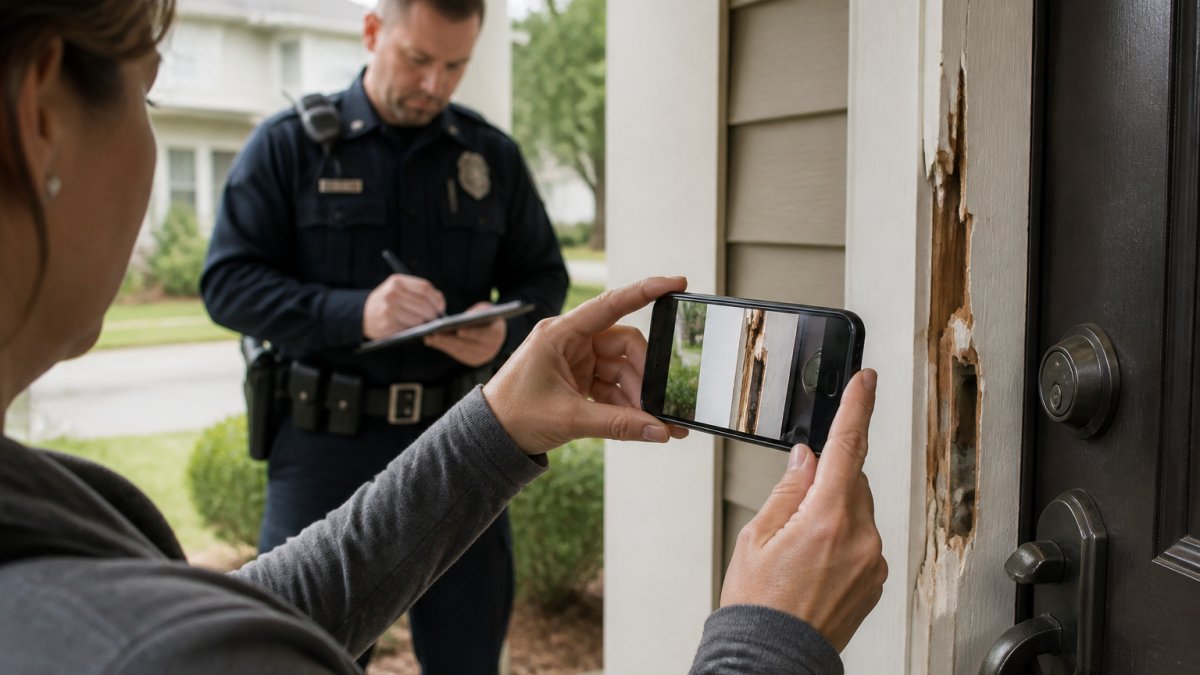
Here's the order that works:
- Get to safety. If the intruder might still be inside, leave and call 911 from outside.
- Call the police. Request an incident report number before they leave.
- Do not clean up. Leave the damage as-is for the officer and later the adjuster.
- Photograph everything. Wide shots of the room, close-ups of the door, frame, and lock.
- List what's missing. Note serial numbers, models, and rough values.
- Call your insurer. Most policies ask you to report promptly.
How to File an Insurance Claim for a Broken Door
Filing an insurance claim for a broken door follows a set path. You report the loss, an adjuster reviews it, and the insurer issues payment minus your deductible.
The whole thing usually takes a few weeks, not days. Here's how to keep it moving:
- Report the claim through your insurer's app or hotline. Give them the police report number.
- Meet the adjuster. Walk them through the damage and hand over your photos.
- Get your own repair estimate. A local door contractor can price the fix independently.
- Review the settlement. Check whether they're paying replacement cost or actual cash value.
- Approve and repair. Once you agree, schedule the work.
Replacement cost pays to buy a new door of similar kind and quality. Actual cash value subtracts depreciation, so you get less. This distinction matters a lot on older doors.
Keep every document. Receipts, emails, the police report, the adjuster's name. If the claim gets disputed, that paper trail is your use.
Your Home Insurance Deductible for Burglary: When Filing Costs More Than Repairing
The home insurance deductible for burglary is the amount you pay before coverage kicks in, and it decides whether filing is even worth it.
Start with the simple math. If your deductible is $1,000 and the door repair runs $800, your insurer pays nothing, yet that claim still lands on your record.
Step 1: Estimate the total loss, not just the door. Add up the door and frame repair, the lock replacement, any interior damage, and the depreciated value of stolen items.
Step 2: Subtract your deductible. That $2,200 loss against a $1,000 deductible means a $1,200 payout. Against a $2,500 deductible, it means nothing.
Step 3: Estimate the premium impact. A single burglary claim commonly raises premiums at renewal, and the increase often persists for several years.
| Door + Contents Loss | Deductible | Estimated Payout | 3-Year Premium Impact (est.) | Net Benefit | File a Claim? |
|---|---|---|---|---|---|
| $700 | $1,000 | $0 | $0 (no payout, but claim on record) | Negative | No |
| $1,200 | $1,000 | $200 | $600-$900 | Negative | No |
| $2,500 | $1,000 | $1,500 | $600-$900 | $600-$900 | Maybe |
| $6,000 | $1,000 | $5,000 | $600-$900 | $4,100-$4,400 | Yes |
| $12,000 | $2,500 | $9,500 | $900-$1,200 | $8,300-$8,600 | Yes |
The threshold most practitioners use: file only when the payout clearly exceeds your deductible plus the expected multi-year premium impact.
One more factor: many policies include a separate wind, hail, or theft deductible that differs from your standard one, so check your declarations page. If you carry a percentage deductible, such as 1% or 2% of dwelling coverage, a $400,000 home means a $4,000 to $8,000 deductible, which changes the math dramatically.
Finally, consider the non-financial cost.
Homeowners Insurance Stolen Property Claim: What Else Gets Covered Beyond the Door
A homeowners insurance stolen property claim covers more than the door, it also covers the items taken, up to your policy limits. Personal property protection typically pays for electronics, jewelry, and furniture taken in the break-in, damaged items inside the home, and sometimes loss of use if the home isn't livable. But watch the caps: high-value items like jewelry, cash, and art often have sub-limits unless you add a rider.
Door Armor Single Door Security Set →
Two more things worth knowing:
- Replacement cost coverage pays today's price for a similar item.
- Actual cash value pays what the item was worth after depreciation.
Document your belongings before anything happens, a ten-minute phone video walking through each room can be worth thousands later.
Repair vs. Replace: What Door Damage Actually Costs After Forced Entry
Repair vs. replace comes down to how the intruder got in: a pried lock usually means a repair, while a kicked-in door often means replacement. The decision also depends on which components failed and whether your insurer will pay for a locksmith, a carpenter, or both. Forced entry damages specific weak points, and here's what each costs to fix based on typical contractor and locksmith pricing:
- The lock cylinder or deadbolt. A locksmith rekeys or replaces a cylinder for roughly $75 to $200, plus a service call of $50 to $100. This is the cheapest fix and the most common after a pry attempt.
- The strike plate and surrounding jamb. When a kick rips the strike plate out of the soft wood, a carpenter or handyman repairs the jamb with wood filler, a metal reinforcement plate, or a new jamb section. Expect $150 to $400 depending on the extent of the split.
- The door frame and jamb. A split jamb often requires removing and replacing the frame, which runs $300 to $800 for labor and materials on a standard exterior door.
- The hinges and hinge side. Bent or pulled hinges usually mean patching the hinge mortise and reinstalling with longer screws. Budget $100 to $300.
- The door slab. A cracked or split slab cannot be reliably repaired. A new exterior door slab runs $200 to $1,500 depending on material, plus $150 to $400 for installation.
So a realistic repair bill after a forced entry often lands between $300 and $1,200 for a repair, and $800 to $2,500 or more for a full door and frame replacement.
Locksmith vs. DIY vs. contractor. A locksmith is the right call for lock and cylinder work, and most insurers treat locksmith charges as a covered repair under dwelling coverage. A handyman or carpenter handles jamb and frame repair.
What insurers actually pay for. Dwelling coverage typically pays to restore the door and frame to their pre-loss condition.
Here's the frustrating part: a standard door and frame are only as strong as their weakest point, and that point is the lock area. Replacing the door without reinforcing it just resets the clock.
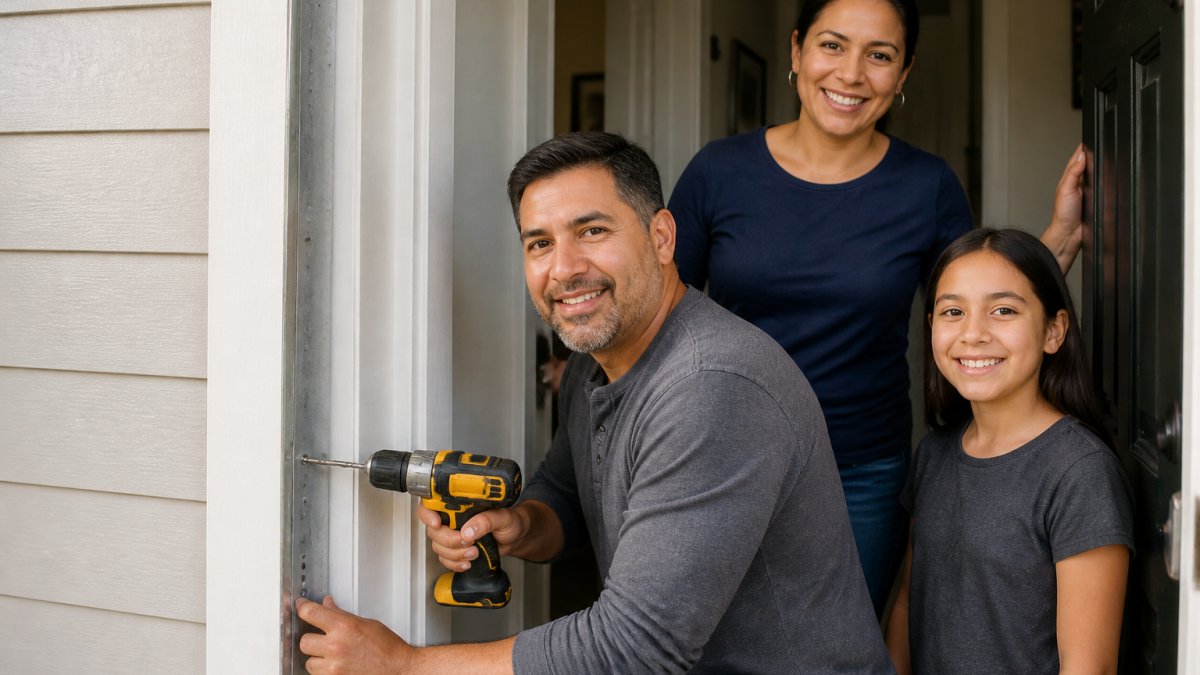
This is where Door Armor comes in. Our patented galvanized steel system reinforces the frame, hinges, and lock area against kick-ins and prying.

How Claims Affect Your Premium and What to Do Differently Next Time
Claims affect your premium, and that's the hidden cost of filing. Even a single burglary claim can raise your rate at renewal or flag your account during underwriting.
Insurers look at claim history when they set rates. A burglary claim tells them your home carries more risk. Some carriers raise the premium. Others add a surcharge. A few may decline to renew.
So the smarter play is prevention. Make your home a harder target than the one next door.
What actually works:
- Reinforce the door frame, hinges, and strike area with steel
- Add a deadbolt and a reinforced strike plate
- Secure sliding glass doors with a locking bar
- Keep the exterior well lit and trim back hiding spots
- Use a security camera or alarm as a visible deterrent
Conclusion: Cover the Repair, Then Prevent the Next One
A break-in leaves you with two problems: the damage now and the risk of a repeat later. Insurance can help with the first. It won't do much for the second.
Most homeowners fix the door and stop there. That's the mistake. The same weak frame that let an intruder in will let the next one in too.
Door Armor exists to close that gap. Our police-tested steel kits reinforce the frame, hinges, and lock area, install in under 30 minutes, and carry a $500 Lifetime Guarantee against kick-ins. Over 500,000 doors secured, 20+ years in the business, and a design that stays discreet against your existing hardware.
Get started with Door Armor and secure the door that insurance can only repair.
Frequently Asked Questions
Does homeowners insurance cover a door damaged during a break-in?
Yes, in most cases. Standard homeowners insurance policies cover door damage caused by burglary or attempted burglary under dwelling coverage, which handles the structure of your home. This includes forced entry damage to the door itself, the frame, locks, and hinges. Your deductible applies before the insurer pays out, so if the repair costs less than your deductible, you would pay out of pocket. Review your coverage exclusions to confirm burglary is not listed as an exclusion on your policy.
Will my deductible be higher than the cost of repairing the door?
It can be. A basic door repair or lock replacement often runs a few hundred dollars, while typical home insurance deductibles range from $500 to $2,000. If your deductible is $1,000 and the repair costs $600, filing a claim makes no financial sense. Compare your deductible against the total repair estimate, including frame damage and any stolen property, before deciding whether to file. Paying out of pocket preserves your claim history and avoids a premium increase.
Do I need to file a police report for a break-in insurance claim?
Most insurers require a police report to process a burglary claim. The report creates an official incident record that verifies the break-in occurred and documents the damage and stolen items. File the report as soon as possible after discovering the break-in, then provide the report number to your adjuster. Without a police report, your claim may be delayed or denied because the insurer has no third-party verification of the loss.
Should I repair the door before the insurance adjuster inspects it?
Do not make permanent repairs before the adjuster sees the damage. Document everything first with photos and video, then secure the door temporarily if needed to prevent further loss. Your policy may cover reasonable temporary repairs, so keep receipts. Once the adjuster completes the inspection and approves the claim, you can hire a contractor for permanent repair or replacement. Repairing first can reduce your reimbursement or void the claim entirely.