 how-to
Why Residential Doors Fail During Forced Entry
Table of Contents
- How Forced Entry Actually Happens to a Residential Door
- The Weak Points: Why the Door Frame and Jamb Fail First
- How to Reinforce a Door Against a Kick-In
- Locks, Deadbolts, and Strike Plates: The Hardware Failure Chain
- Hinges, Glass Panels, and the Parts Homeowners Overlook
- Are Forced Entry Resistant Doors Worth It?
- Conclusion
- Frequently Asked Questions
Last Updated: October 4, 2026
How Forced Entry Actually Happens to a Residential Door
Most people picture a burglar picking a lock. At Door Armor, we've spent over 20 years studying where that force lands.
A residential door is a system: panel, frame, jamb, hinges, lock, and strike plate. Force travels through all of them, and when one part fails, the whole assembly fails.
Here's what most homeowners never hear: the lock is usually the strongest piece in the setup, and the wood around it is the weakest.
FBI Uniform Crime Reporting program data on burglary
The Three Failure Modes: Splintering, Shearing, and Bending
Forced entry resistance comes down to three physical outcomes. Understanding them tells you exactly what to reinforce.
- Splintering: The wood frame or jamb cracks and breaks apart around the strike plate.
- Shearing: Screws snap or pull straight out of the wood under sudden force.
- Bending: Metal parts like hinges, strike plates, or lock bolts deform and stop working.
A kick delivers brute force in a fraction of a second; a pry bar applies sustained force over several seconds. Both attack the same weak points. Splintering and shearing happen fast; bending shows up later, as a door that won't close right or a lock that sticks.
The Weak Points: Why the Door Frame and Jamb Fail First
The door frame and jamb fail first because they're soft wood holding hard metal. A deadbolt might be steel, but it sits inside a wooden jamb often less than an inch thick.
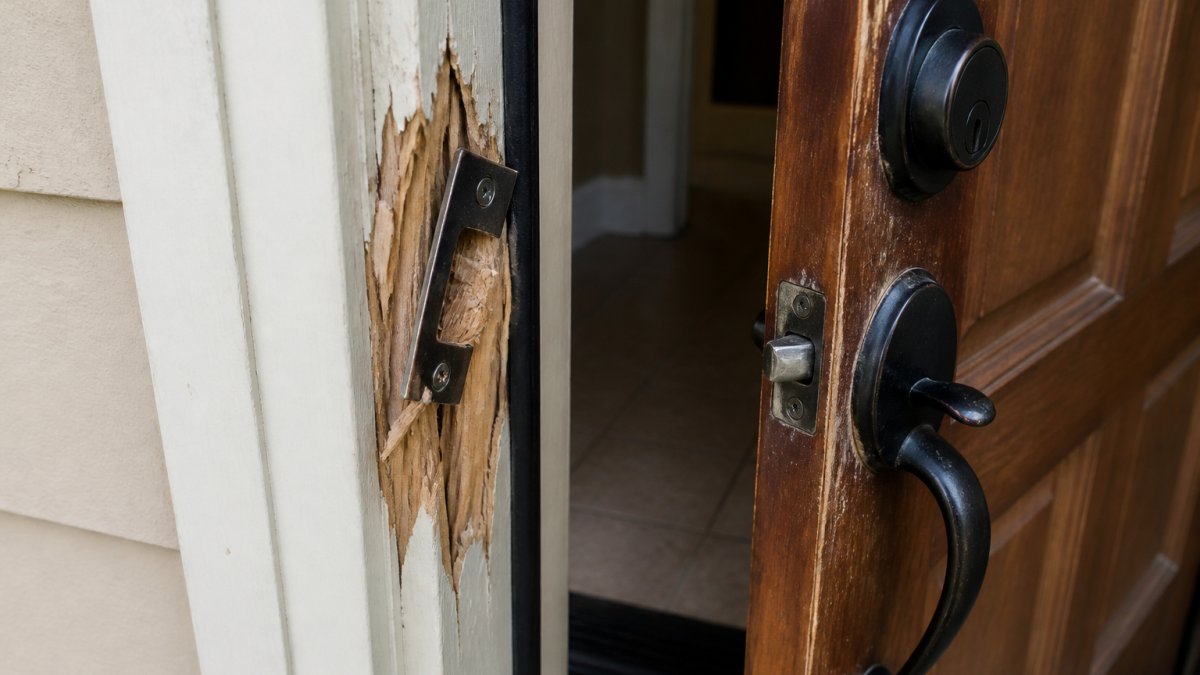
Door frame reinforcement matters more than most people realize. The strike plate that catches the lock bolt screws into the jamb, the vertical piece the door closes against.
Why Short Screws Undermine Door Frame Reinforcement
Short screws are the single biggest weakness in a typical door assembly. When a door takes a hit, the lock bolt pushes hard against the strike plate.
Short screws pull out of soft wood with almost no resistance. The jamb splits. The strike plate flies off. The door swings open.
The fix is simple: longer screws that reach the stud behind the jamb, the framing lumber that actually holds your house together.
How to Reinforce a Door Against a Kick-In
Learning how to reinforce a door against a kick-in starts with the lock area, the hinges, and the frame. You don't need to replace the door.
Here's a practical checklist you can work through in an afternoon:
- Replace strike plate screws with 3-inch screws that reach the wall stud
- Add a heavy-duty strike plate or a steel jamb shield over the existing one
- Reinforce the hinge side so the door can't be pried or kicked off its hinges
- Check that the deadbolt extends at least 1 inch into the jamb
This is the approach behind a forced entry resistant door setup: you're not making the door unbreakable, you're buying time.
The Door Armor Single Door Security Set uses galvanized steel to reinforce the frame, hinges, and lock area at once.
Locks, Deadbolts, and Strike Plates: The Hardware Failure Chain
A deadbolt is only as strong as the strike plate that catches it, and the strike plate is only as strong as the wood it's screwed into. That's the hardware failure chain: bolt, strike plate, screws, jamb, wall stud. Break any link and the whole chain gives out, no matter how expensive the lock was.
Here's how force actually moves through that chain during a kick or pry:
- The bolt takes the hit. A deadbolt throws a bolt roughly 1 inch into the jamb. That bolt is hardened steel and almost never bends or snaps first.
- The bolt pushes the strike plate. Force transfers from the bolt into the strike plate's lip and screw holes.
- The strike plate pulls on the screws. The plate tries to rotate away from the jamb, loading the screws in tension and shear.
- The screws load the jamb. Short screws sit in the soft outer inch of the jamb; long screws reach the stud behind it.
- The jamb loads the wall. If the jamb is anchored to the framing, force dissipates into the wall. If it isn't, the jamb splinters and the door swings free.
What Actually Decides Whether the Chain Holds
- Bolt throw length. A 1-inch deadbolt resists prying far better than a half-inch spring latch. A latch alone is a latch, not a lock.
- Bolt material and hardening. A hardened steel bolt resists sawing and cutting; a soft bolt can be scored and snapped.
- Strike plate gauge and size. A heavy steel plate with a deep lip spreads force across more wood than a thin stamped plate with a shallow lip.
- Screw length and diameter. This is the link that fails most often. Standard strike plate screws are often under 1 inch long. Three-inch screws that reach the wall stud change the outcome.
- Number of screws. A plate held by two screws concentrates force on two points. A plate held by four or more spreads it.
Why Lock Failure Is Almost Never the Lock's Fault
When a homeowner reports that "the lock failed" during a break-in, the lock usually didn't fail, the mounting did. The bolt stayed intact while the strike plate tore out of the jamb, or the jamb itself split around the plate.
Door Armor Single Door Security Set →
A useful way to think about it: the lock is the strongest link in a typical residential assembly, and the wood around it is the weakest.
Hinges, Glass Panels, and the Parts Homeowners Overlook
Hinges and glass panels are the quiet weak points in a door assembly. Homeowners focus on the lock and forget everything else, but a determined intruder looks for the easiest path, often the hinge side or a glass panel.
How the Hinge Side Fails
Hinges carry the full weight of the door and absorb force from the hinge side. Two failure modes matter:
- Screw pullout. Hinge screws are typically short and sit in the soft edge of the jamb or the door slab. Under a pry bar or a hard kick, they pull straight out and the hinge separates from the frame.
- Pin removal on out-swinging doors. If a door swings outward, the hinge pins face the exterior. An intruder can pop the pins, lift the door out of the hinges, and walk in without touching the lock. This is one of the most overlooked residential vulnerabilities, and it only applies to out-swinging doors.
Hinge-side reinforcement, sometimes called hinge shields, anchors the hinge screws into the framing and covers the pin side so the door can't be lifted or pried off. On in-swinging doors, the hinge side is less exposed to pin removal but still vulnerable to screw pullout under prying.
How Glass and Vision Panels Fail
Glass panels and vision panels fail by design: glass shatters. A vision panel near the lock lets someone reach through, turn the deadbolt from the inside, and open the door. Full-lite and half-lite doors have the same issue at a larger scale.
On doors with side lights, there often isn't a real jamb to anchor into at all, making those doors some of the hardest to secure.
A Non-Destructive Inspection You Can Do Today
You don't need tools to find most of these weak points. Walk your entry door and check:
- Push the door near the lock and near the hinges. Any wobble or flex means the frame or hardware is already loose.
- Look at the hinge pins from the outside. If you can see the pin heads on an out-swinging door, that door can be lifted off its hinges.
- Check the hinge screws. If they're short and sitting in soft wood, they're a pullout risk.
- Look for cracks, splits, or soft spots in the jamb around the strike plate and hinges.
- Confirm whether the lock side has a real jamb or only a narrow mullion, especially on doors with side lights.
What to Do About Each One
- Loose or short hinge screws: Replace with longer screws that reach the framing, and add hinge-side reinforcement.
- Out-swinging hinge pins: Add hinge shields or security hinges that resist pin removal.
- Vision panel near the lock: Move the lock out of reach, add a double-cylinder deadbolt where code allows, or reinforce the panel with security glazing.
- Side lights and narrow mullions: Add a kit that screws back into the face of the jamb to create the rigidity that's missing.
- Double doors: There's no center jamb to hold a lock, so add a barricade that secures the middle.
Are Forced Entry Resistant Doors Worth It?
Forced entry resistant doors are worth it when they reinforce the whole assembly, not just the panel.
So how do you decide what to spend? Use this quick comparison:
| Approach | What It Fixes | Best For | Time to Install |
|---|---|---|---|
| Longer strike plate screws | Short-screw shearing | Renters, quick fixes | Under 30 minutes |
| Steel jamb and hinge shields | Frame and hinge failure | Most homeowners | About 30 minutes |
| Full door replacement | Everything, if framed right | New builds, major remodels | Hours to days |
| Glass and sidelight kits | Vision panel and side light gaps | Doors with glass | About 30 minutes |
A steel reinforcement kit sits in the sweet spot: it costs far less than a new door and fixes the parts that actually fail.
We've secured over 500,000 doors, and the goal is always the same: buy the critical seconds that let you call for help or get to safety.
Conclusion
Every residential door has a weakest link, and intruders find it fast. The good news: the fix is usually the frame and hardware, not the whole door.
To stop forced entry before it starts, reinforce the parts that fail first. Door Armor's patented steel system strengthens the frame, hinges, and lock area with a DIY install in under 30 minutes, backed by a $500 Lifetime Guarantee and trusted by homeowners and police alike.
Get started with Door Armor and give your family the time that matters most.
Frequently Asked Questions
What part of a residential door usually fails first during a forced entry?
The frame and jamb typically fail before the door panel itself. Most residential doors are built with soft wood frames and short screws that only reach the trim, not the structural studs. When a kick or pry bar applies force, the wood around the strike plate splinters and the jamb shears away from the wall. The lock bolt stays intact but the frame it sits in gives way, allowing the door to swing open.
Can a door frame fail even if the door itself is solid?
Yes. A solid-core door can withstand the impact, but the frame holding it may not. Standard frames are often pine or composite, and the strike plate is secured with screws under 1 inch long. Those screws pull out of soft wood under sustained force, so the door swings free even though the panel is undamaged. This is why door frame reinforcement matters as much as the door material itself.
How can homeowners reinforce an existing door without replacing it?
You can reinforce an existing door by replacing short hinge and strike plate screws with 3-inch screws that reach the wall studs, installing a heavy-duty strike plate, and adding steel reinforcement plates around the lock and hinge areas. A galvanized steel kit like the Door Armor Single Door Security Set installs in about 30 minutes and covers the jamb, hinges, and lock zone without removing the door.
Do deadbolts make a residential door more resistant to forced entry?
A deadbolt helps, but only if the frame and strike plate can hold it. A 1-inch deadbolt bolt in a reinforced strike plate resists prying and shimming far better than a spring latch. However, if the strike plate is held by short screws in soft wood, the bolt simply tears through the jamb. Pairing a quality deadbolt with door frame reinforcement gives you the resistance you expect.