 how-to
How to Secure a Door Against Kick-Ins in 2026
Table of Contents
- How a Kick-In Actually Works (and Where Your Door Fails)
- What You'll Need Before You Start
- Step 1: Replace Short Strike Plate Screws With 3-Inch Screws
- Step 2: How to Strengthen Door Frame Weak Points With a Door Reinforcement Kit
- Step 3: How to Prevent Forced Entry at the Lock and Hinges
- Step 4: Securing Glass Doors, Sidelights, and Double Doors
- Rental-Friendly and Smart Lock Options That Still Stop Kick-Ins
- Your 5-Minute Visual Inspection Checklist
- Frequently Asked Questions
Last Updated: October 2, 2026
How a Kick-In Actually Works (and Where Your Door Fails)
Most people picture a burglar picking a lock. In reality, the fastest way through a locked door is a hard kick to the frame.
Here's the part that surprises people: the lock almost never fails. The wood around it does.
A kick-in is a physics problem.
At Door Armor, we've spent over 20 years studying where doors fail under impact.
The Three Points That Give Way First
Almost every kick-in fails at the same three spots:
- The strike plate: held in by short screws that pull straight out of the soft jamb wood.
- The door jamb: the thin strip of wood the lock sits in, which splits under force.
- The hinges: standard screws strip out, letting the door fall inward.
Fix all three and a kick stops working.
What You'll Need Before You Start
Gather your tools first.
- Cordless drill with a Phillips bit
- 3-inch screws (the single biggest upgrade you can make)
- A door reinforcement kit with steel jamb and hinge shields
- Screwdriver, tape measure, and a pencil
- Safety glasses
Set aside 30 minutes per door, and measure twice before you drill.
U.S. Department of Justice guidance on home security and burglary prevention
Step 1: Replace Short Strike Plate Screws With 3-Inch Screws
The fastest fix is also the cheapest. Strike plates usually come with screws under an inch long, which grab only the jamb, not the wall behind it.
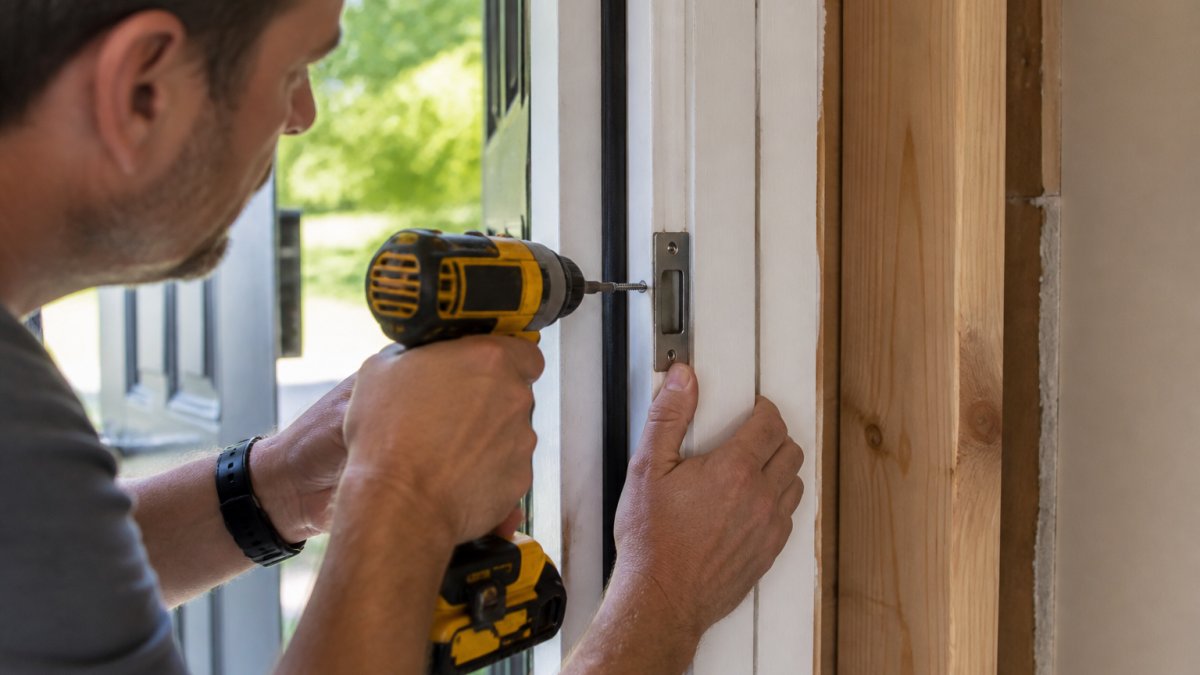
Swap them for 3-inch screws that reach the wood stud framing your door.
Here's how:
- Remove the two short screws from the strike plate.
- Drive a 3-inch screw into the top hole until it bites the stud.
- Repeat for the bottom hole.
One warning: not every hole lines up with a stud. If a screw spins without grabbing, don't over-tighten and strip the wood. Move to the next hole.
Step 2: How to Strengthen Door Frame Weak Points With a Door Reinforcement Kit
Screws help, but the jamb itself is still soft wood. A door reinforcement kit wraps that wood in steel so it can't split, bolting a shield over the jamb at the lock and hinges. This is how you strengthen door frame weak points for good, spreading the force of a kick across the whole frame instead of one small spot.
Jamb Shields, Hinge Shields, and What Each One Does
- Jamb shield: a steel plate that covers the lock area and strike plate, so the wood can't split.
- Hinge shield: steel plates that tie the hinges into the stud, stopping the door from falling inward.
- Door slab reinforcement: some kits also brace the slab itself, useful for hollow-core doors.
Together these parts give you kick-in resistance that plain wood can't match.
Step 3: How to Prevent Forced Entry at the Lock and Hinges
A strong lock is useless if the hinges fail. To prevent forced entry, protect both ends of the door, a kick-in is really two attacks at once.
The Lock-Side Attack
When a boot lands next to the lock, force travels through the door slab into the deadbolt, then the strike plate, then the jamb. Three things determine whether that chain holds:
- Bolt throw. A deadbolt that extends 1 inch into the frame engages the jamb and, ideally, the stud behind it. A 1/2-inch throw barely clears the trim. Look for a full 1-inch throw on exterior doors.
- Bolt material and design. A solid steel bolt resists cutting and bending better than a hollow or sintered one. A bolt with a hardened steel insert or a free-spinning saw-resistant collar is harder to defeat with a reciprocating saw through the gap.
- Strike plate size and anchoring. A standard strike plate is small and thin. A heavy-duty strike plate, often called a security strike or box strike, is longer, thicker, and uses multiple long screws that reach the stud. This is the single most important lock-side upgrade.
The Hinge-Side Attack
Most people never think about the hinges, which is exactly why intruders do. If the hinge screws are short, a kick or pry bar pops the hinge side inward while the lock side stays intact, the door simply swings the wrong way.
Door Armor Single Door Security Set →
Hinge-side fixes, in order of impact:
- Replace the two short screws in each hinge with 3-inch screws that reach the stud behind the jamb. This alone stops most hinge-side kick-ins.
- Add hinge shields or a hinge-side reinforcement plate. These are steel plates that bolt through the jamb into the framing and tie the hinge leaf to the structure.
- Check the top hinge first. It carries the most leverage and is the most common point of failure.
The Order That Actually Matters
Do these in sequence, because each one protects a different failure point:
- Upgrade the deadbolt to a heavy-duty model with a full 1-inch throw and a reinforced bolt.
- Install a heavy-duty security strike plate anchored with 3-inch screws into the stud.
- Replace hinge screws with 3-inch screws, then add hinge shields if the door is a primary entry point.
- Confirm the strike plate is bolted into the stud, not just the trim, if a screw spins freely, it missed the stud.
UL Solutions standards for door hardware and locks
Step 4: Securing Glass Doors, Sidelights, and Double Doors
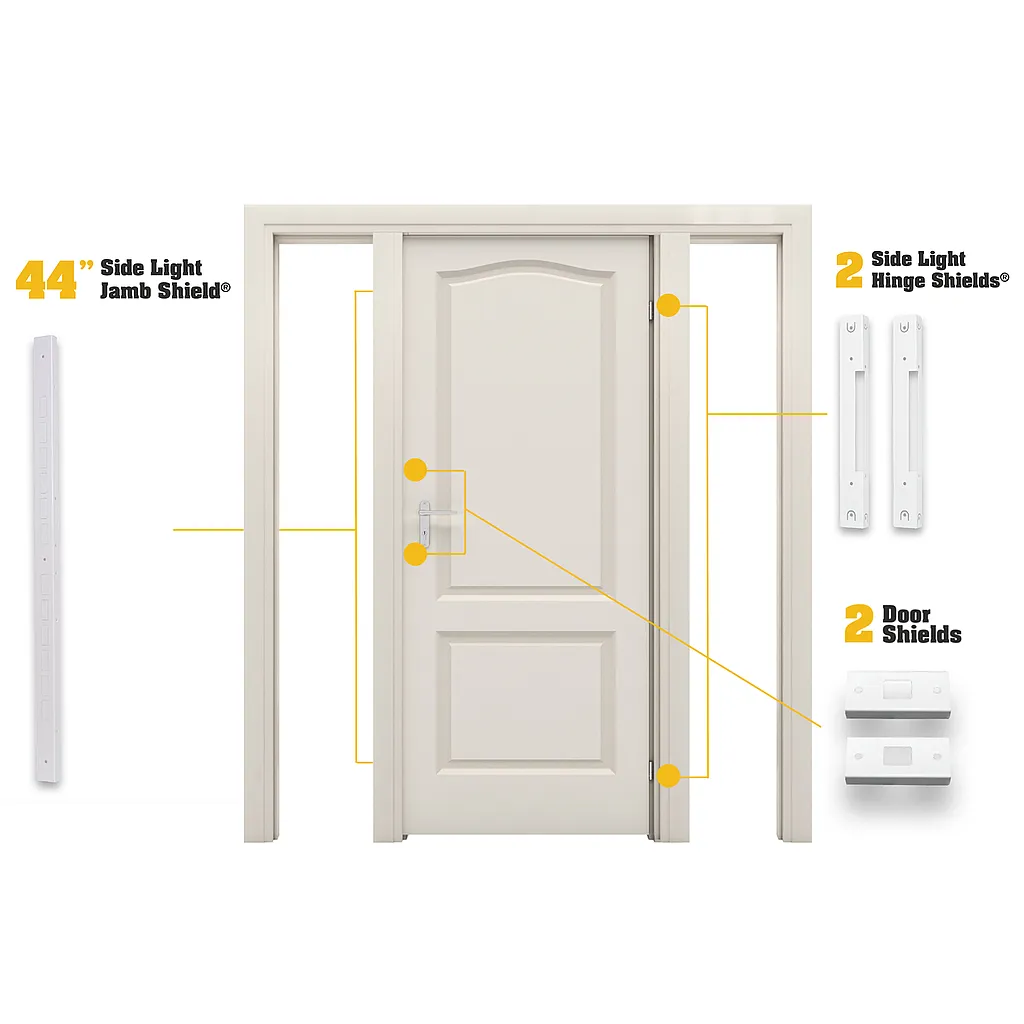
Glass entry doors and doors with sidelights are the hardest to protect, they often have no real jamb for a strike plate to grip, so a standard kit won't fit. You need hardware that screws into the face of the jamb to create rigidity: sidelight jamb shields anchor the frame top and bottom, and hinge shields tie the side panel in place.
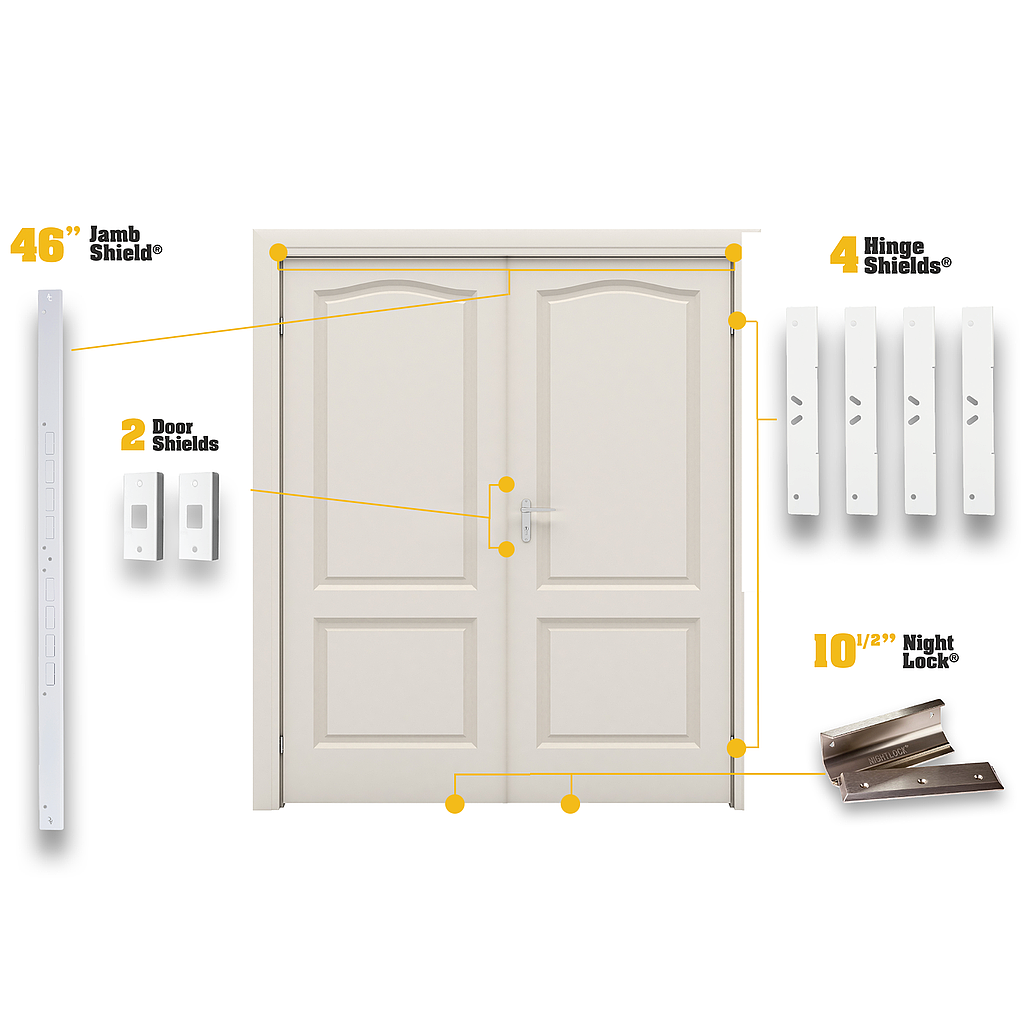
Double doors are their own problem. With no center jamb, there's nothing for a lock to catch. The fix is a door barricade or night lock that secures the active door to the frame. Door Armor's Side Light Door Security Kit and Double Door Security Kit are built for exactly these gaps.
Rental-Friendly and Smart Lock Options That Still Stop Kick-Ins
Most door-security guides assume you own the place and can drill wherever you want, leaving out renters and anyone who wants protection without permanent modification. This section covers both, non-destructive options that work, and how smart locks fit into a reinforced door.
Rental-Friendly Reinforcement That Leaves No Trace
The strongest fixes, long screws into the stud, steel jamb shields bolted through the frame, are permanent. But renters can still raise the bar without losing a deposit:
- Longer strike plate screws, swapped back before move-out. Replacing the two short factory screws with 3-inch screws is reversible: keep the originals in a bag, and swap them back when you leave. The screw holes are hidden behind the strike plate, so there is nothing visible to flag.
- A door security bar or brace. These are removable bars that wedge under the doorknob or seat into a floor-mounted bracket. They apply force against the floor rather than the jamb, so they do not rely on the frame at all. No drilling required for the basic models.
- A portable door jammer. A small metal wedge that slots into the strike side of the door and braces against the floor. It travels with you and works on most inward-swinging doors.
- Hinge pin locks or hinge bolts. Some designs replace the hinge pin without modifying the jamb, blocking the door from being lifted or popped off the hinge side.
What renters generally cannot do: install a full steel jamb shield system, replace the door slab, or add a floor bolt without landlord approval. A removable bar is weaker than a bolted steel kit, but far stronger than nothing.
How Smart Locks Interact With Reinforced Hardware
A smart lock is a convenience and access-control device, not a kick-in defense. A kick-in attacks the frame, not the keypad, the electronics, motor, and Bluetooth radio do nothing against several hundred pounds of force hitting the jamb. Some smart locks even have a shorter bolt throw or lighter-duty bolt than a good mechanical deadbolt, making the lock side weaker, not stronger.
That doesn't make smart locks a bad choice, they just need physical reinforcement:
- Keep the reinforced strike plate. The smart lock's bolt still has to land in something. A heavy-duty strike plate anchored to the stud is what actually resists the kick.
- Check the bolt throw before you buy. Look for a smart lock rated for exterior doors with a full 1-inch throw. Many entry-level models are designed for interior or light-duty use.
- Do not rely on auto-lock alone. Auto-lock is convenient, but it does not change the physics of the frame.
- Consider a smart lock plus a separate mechanical deadbolt. Some setups use the smart lock for daily entry and a keyed deadbolt for when you are home or away for long periods.
Matching the Option to the Situation
| Situation | Best Non-Destructive Option | What It Protects | Reversible? |
|---|---|---|---|
| Renter, standard door | 3-inch strike plate screws (swapped back at move-out) | Strike plate and stud | Yes |
| Renter, cannot modify anything | Portable door jammer or security bar | Whole door, floor-braced | Yes |
| Renter, hinge-side worry | Hinge pin lock or replacement hinge pin | Hinge side | Yes |
| Homeowner, smart lock installed | Smart lock plus heavy-duty security strike plate | Lock side | Permanent |
| Homeowner, high-risk entry | Full steel jamb and hinge system | Jamb, hinges, lock | Permanent |
For homeowners who want a tested, all-in-one answer, Door Armor's Single Door Security Kit covers the jamb, hinges, and lock area in one install. It carries a $500 Lifetime Guarantee against kick-ins.

Your 5-Minute Visual Inspection Checklist
Run this check on every exterior door each season.
- Strike plate screws are 3 inches and bite the stud
- No cracks or splits in the door jamb
- Deadbolt throws at least 1 inch into the frame
- Hinges are tight with no stripped screws
- Door slab is solid, not hollow-core
- Glass panels and sidelights have reinforcement
- No gaps between the door and frame
If you spot a split jamb or loose hinge, fix it before anything else. Those are the exact points a kick targets.
A determined intruder only needs one weak door. Most homes have several, and the weak points are always the same: short screws, thin jambs, and unprotected hinges. Door Armor makes steel reinforcement that installs in under 30 minutes, covers the jamb, hinges, and lock, and stays active without power or batteries.
Frequently Asked Questions
What is the best way to reinforce a door against a kick-in?
The most effective approach targets all three failure points: the strike plate, the door jamb, and the hinges. Start by replacing the short screws in your strike plate with 3-inch screws that reach the wood stud behind the jamb. Then install a door reinforcement kit with steel jamb shields and hinge shields. A deadbolt with a reinforced strike plate adds another layer. This combination prevents the frame from splitting and the door from giving way under repeated kicks.
How do I strengthen a door frame to prevent break-ins?
Strengthening your door frame means connecting it to the structural framing behind it. The jamb itself is typically soft pine that splits easily. Steel jamb reinforcement plates screw through the jamb into the wood stud, distributing force across a wider area. Adding hinge shields on the opposite side prevents the door from being kicked inward at the hinges. For doors with sidelights, specialized jamb shields screw into the face of the jamb to create rigidity where there is no traditional frame.
Are door reinforcement kits effective against forced entry?
Yes. Door reinforcement kits work by reinforcing the specific points that fail during a kick-in: the strike plate, jamb, and hinges. Galvanized steel plates and shields absorb and redistribute the force of an impact, making it much harder for a door to give way. Police departments often recommend these kits because they address the structural weaknesses that make residential doors vulnerable. Many kits install in under 30 minutes with basic tools and provide permanent protection without requiring power or batteries.
Do deadbolts alone prevent door kick-ins?
A deadbolt helps, but it is not enough on its own. The bolt itself may hold, but the wood jamb around the strike plate can split under force, allowing the door to swing open even with the deadbolt extended. To prevent kick-ins, pair your deadbolt with a reinforced strike plate and 3-inch screws that anchor into the wall stud. Adding steel jamb shields provides the structural integrity the deadbolt needs to stay effective.