 how-to
How to Reinforce a Front Door Frame: 2026 Guide
Table of Contents
- Why Your Front Door Frame Is the Weakest Entry Point
- What You'll Need: Tools and Materials
- Upgrading Your Door Security Strike Plate
- Installing Heavy Duty Door Hinge Screws
- How to Reinforce a Front Door Frame with Door Jamb Armor
- Door Reinforcement Kit Installation: Step-by-Step
- Common Mistakes to Avoid When Reinforcing a Door Frame
- Conclusion
Last Updated: August 9, 2026
Why Your Front Door Frame Is the Weakest Entry Point
Most forced entries come through a kicked-in door. The frame splits, the jamb cracks, and the whole assembly fails in seconds because the wood surrounding it can't absorb the impact. Door frame reinforcement hardens the structural elements, jamb, strike plate, hinges, and casing, to resist kick-in attacks and prying. Standard residential frames use thin pine or fir that splits under a single hard kick, even when the door itself is solid.
At Door Armor, we've spent over 20 years analyzing how forced entry happens. The answer is always the same: the door loses because the frame fails first.
Visual Inspection Checklist Before You Start
Run through this before you buy anything:
- Check the strike plate screws, are they shorter than 3 inches? If yes, this is your first priority.
- Inspect the door jamb for cracks, soft spots, or cracked paint along the grain.
- Look at the hinge side. Are hinges recessed or surface-mounted? Surface-mounted hinges are a vulnerability.
- Open and close the door, does it rattle in the frame? Excessive play means poor latch-to-strike contact.
- Check the door casing. If it's hollow or thin, it offers no structural contribution.
- Look for daylight gaps around the door perimeter. Gaps wider than 1/8 inch allow prying tools to gain purchase.
- Test the deadbolt throw, does it extend fully into the strike plate? A partial throw reduces resistance.
Write down what you find. This list tells you exactly where to spend your time and money.
What You'll Need: Tools and Materials
Reinforcing a front door frame is a DIY-friendly project taking under an hour with basic hand tools.
Tools:
- Power drill with Phillips and flathead bits
- Drill bits matched to your screw diameter (typically 3/32" pilot bit)
- Tape measure
- Utility knife or chisel
- Hammer
- Level
Materials:
- Long-reach security screws (3-inch minimum, ideally 3.5 inches)
- Heavy-duty steel strike plate
- Door hinge security screws
- Door reinforcement kit or door jamb armor (galvanized steel preferred)
- Optional: door barricade bar or secondary lock
Check Door Armor's website for current pricing on galvanized steel reinforcement systems.
| Reinforcement Method | DIY Difficulty | Rental-Friendly | Primary Weakness It Fixes |
|---|---|---|---|
| Strike plate upgrade | Easy | Yes | Latch-side kick-in |
| Long-reach security screws | Easy | Yes | Frame split at strike |
| Hinge security screws | Easy | Yes | Hinge-side prying |
| Door reinforcement kit | Moderate | Mostly yes | Full jamb failure |
| Door jamb armor | Moderate | Depends on kit | Full forced entry |
| Solid-core door upgrade | Hard | No | Door panel failure |
Upgrading Your Door Security Strike Plate
The door security strike plate is the single most impactful upgrade for the least money. A standard builder-grade strike plate is a thin stamped-metal rectangle held by two half-inch screws. One solid kick and the wood blows out. A heavy-duty steel strike plate uses thicker gauge steel and a longer mounting surface that distributes impact force across more of the door jamb.
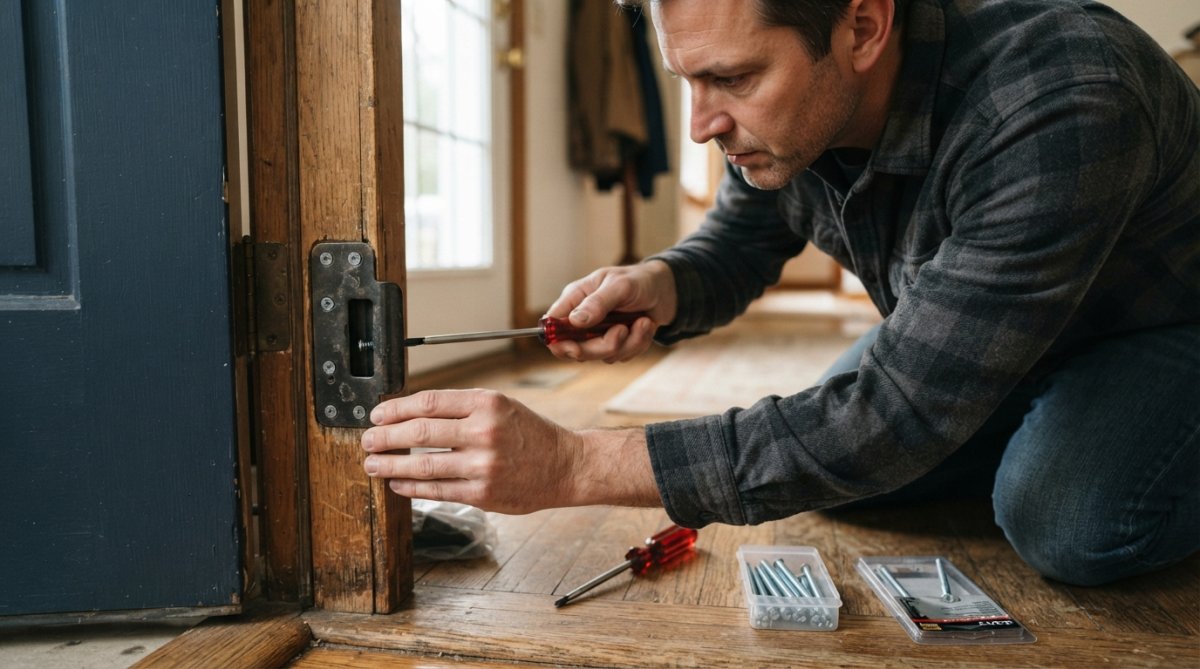
How to install a reinforced strike plate:
- Remove the existing strike plate by unscrewing the mounting screws.
- Hold the new strike plate in position. Most security plates are longer than standard and will require a small chisel to extend the mortise.
- Use a utility knife or sharp chisel to deepen and extend the mortise so the new plate sits flush.
- Pre-drill pilot holes to prevent the jamb wood from splitting.
- Drive the long security screws through the strike plate, through the jamb, and into the structural framing behind it.
How Long Should Strike Plate Screws Be?
Strike plate screws should be at least 3 inches long, with 3.5 inches preferred for maximum security. Standard screws that ship with most door hardware are only 3/4 inch to 1 inch long, they barely reach the door jamb itself, let alone the structural framing stud behind it. The goal is to anchor the strike plate into the king stud or jack stud framing, not just the jamb wood.
According to the US Department of Homeland Security's home security guidance, reinforcing door hardware with longer fasteners is one of the most cost-effective ways to harden a residential entry point against forced entry. Three-inch screws that reach the structural framing increase kick-in resistance dramatically compared to standard hardware.
Installing Heavy Duty Door Hinge Screws
Most guides focus entirely on the latch side and ignore the hinge side. A door with a reinforced strike plate but weak hinges can still be pried off the frame by attacking the hinge side, a method burglars use when they notice a deadbolt.
Heavy duty door hinge screws work on the same principle as long strike plate screws: they extend through the door frame and into the structural framing stud behind it. Standard hinge screws are typically 3/4 inch. Replacing them with 3-inch screws on each hinge anchors the hinge side into the actual house framing.
Installation process:
- Work one hinge at a time, do not remove all screws simultaneously or the door will sag.
- Remove one screw from the door-side hinge leaf and replace it with a 3-inch security screw. Repeat for each hole.
- Move to the jamb-side hinge leaf and repeat, ensuring screws reach the framing stud.
- Test the door swing after each hinge. If the door binds, the screw may be slightly misaligned.
For doors with three hinges, prioritize the top and bottom hinges first. Security hinges with non-removable pins are worth considering if your door swings outward.
How to Reinforce a Front Door Frame with Door Jamb Armor
Door jamb armor is the most comprehensive way to reinforce a front door frame against forced entry. It consists of steel plates that wrap around the door jamb, covering the strike plate area, hinge area, and full length of the frame, so that a kick distributes force across a large steel surface instead of concentrating it on a small wood section.
Door Armor's patented galvanized steel system is police-tested and police-recommended, backed by a $500 Lifetime Guarantee against kick-ins, and designed to be installed by homeowners in under 30 minutes.
Solid-Core and Steel Door Compatibility
Door jamb armor works with most standard residential door configurations, but the door itself matters too. A solid-core door paired with reinforced frame hardware creates a genuinely resistant entry point. A hollow-core door with the best jamb armor is still a weak system.
Solid-core doors use a solid wood or composite core and weigh significantly more than hollow-core doors, resisting impact to the door panel itself. Steel doors offer even greater panel resistance. A steel door with a solid core and a reinforced frame is the most impact-resistant combination available for residential use.
Door Armor's system is compatible with both wood and steel door frames, including most standard door widths. Check the product specifications on their website if you have a non-standard door width or an older home with irregular framing.
Rental-Friendly Reinforcement Options
Renters face a real problem: most serious reinforcement methods require drilling into walls and frames, which can violate lease agreements. Several effective options don't require permanent modification.
Non-destructive reinforcement methods for renters:
- Door barricade bars brace against the floor and door surface, preventing inward kick-in without any drilling.
- Portable door locks wedge under the door handle or latch to prevent the handle from turning.
- Security door bars adjust under the door handle and angle to the floor with no installation required.
- Surface-mounted strike plate reinforcers can be installed with screws short enough to stay within the jamb wood, avoiding structural framing.
The Door Armor system can be removed when you move, making it practical for renters with landlord approval. According to the National Crime Prevention Council's home security resources, renters are statistically more likely to live in multi-unit buildings where entry point security is inconsistent, making removable reinforcement options especially relevant for this group.
Door Reinforcement Kit Installation: Step-by-Step
A door reinforcement kit bundles the key components, strike plate armor, hinge reinforcement, and jamb plates, into a single package designed to work together. Installation takes most homeowners 30-45 minutes.
Step 1: Gather your tools. [Time: 5 minutes] Drill, appropriate bits, tape measure, utility knife, and the hardware from your kit.
Step 2: Remove existing strike plate. [Time: 5 minutes] Unscrew and set aside the old strike plate. Inspect the jamb wood underneath for damage or soft spots. If badly damaged, fill with wood hardener or epoxy filler and let it cure before proceeding.
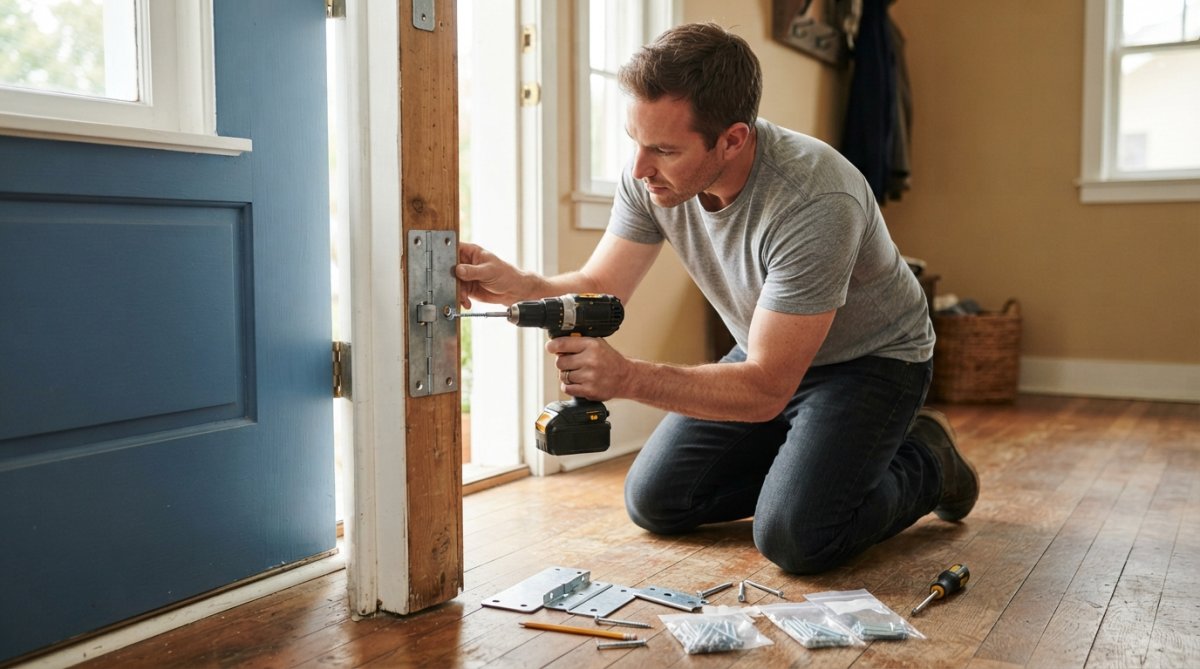
Step 3: Install the jamb reinforcement plates. [Time: 10 minutes] Position the steel jamb plates along the door frame, aligning them with the existing mortises. Mark screw hole positions with a pencil.
Step 4: Pre-drill all pilot holes. [Time: 5 minutes] This prevents wood splitting and ensures screws drive straight.
Step 5: Drive the security screws. [Time: 10 minutes] Start with the strike plate area. Drive screws through the steel plate, through the jamb, and into the structural framing. Confirm each screw is seated flush.
Step 6: Reinstall or replace the strike plate. [Time: 5 minutes] Position the new heavy-duty strike plate over the reinforcement plate and secure it. Test the latch and deadbolt throw, both should engage smoothly.
Step 7: Test the door. [Time: 5 minutes] Open and close the door multiple times. Check for binding, alignment issues, or gaps. The door should operate identically to before.
Acoustic and Weather-Stripping Considerations
Adding steel plates and thick hardware to a door frame can compress or displace existing weather stripping, creating gaps that affect energy efficiency and noise transmission. Before you finalize installation, check that the door compresses weather stripping evenly when closed, the door stop remains aligned, and acoustic seals make full contact around the perimeter.
If you notice gaps after installation, self-adhesive foam weather stripping can be added to the jamb face to restore the seal. As noted in the US Department of Energy's guidance on door air sealing, gaps around entry doors are a leading cause of residential energy loss.
Common Mistakes to Avoid When Reinforcing a Door Frame
The biggest mistake is treating this as a one-and-done upgrade for just one component. A reinforced strike plate with weak hinge screws is still compromised. Forced entry resistance requires the whole system to work together.
Mistake 1: Using screws that are too short. Many homeowners replace their strike plate but use the screws that came in the package, which are often 1 inch or less. If the screws don't reach the structural framing, the upgrade provides minimal additional resistance.
Mistake 2: Skipping the hinge side. The hinge side of the door is a genuine attack vector. Reinforcing only the latch side leaves half the door frame unprotected.
Mistake 3: Installing on a damaged jamb without repairing it first. Driving screws into cracked or soft wood creates the illusion of security. Fill and cure any damage before installing reinforcement hardware.
Mistake 4: Ignoring the door itself. Frame reinforcement on a hollow-core door is like putting a deadbolt on a screen door. Reinforce the frame and upgrade the door together.
Mistake 5: Not testing after installation. A door that binds, doesn't latch cleanly, or has visible gaps after reinforcement hasn't been properly installed. Always test before considering the job done.
According to FBI Uniform Crime Reporting data on residential burglary, the majority of residential burglaries involve forced entry through doors, which means the steps covered in this guide directly address the most common attack method used against homes.
A properly reinforced door frame with long security screws, a heavy-duty strike plate, hinge security hardware, and door jamb armor represents a fundamentally different security proposition than a standard residential entry. The goal isn't to make your door impossible to breach, it's to make it take long enough that an attacker gives up and moves on.
Most homeowners don't think about door frame security until after a break-in. Reinforcing your front door frame is one of the highest-return security upgrades available and well within DIY reach. Door Armor's patented galvanized steel system covers every weak point in a single installation, is police-tested, backed by a $500 Lifetime Guarantee, and designed to be installed in under 30 minutes without a contractor. Shop Door Armor to get your entry points secured before they're tested.
Frequently Asked Questions
Can I reinforce a door frame without replacing it?
Yes. Replacing the entire frame is rarely necessary. Installing a heavy-duty strike plate with 3-inch security screws, adding door jamb armor or a full reinforcement kit, and upgrading hinge fasteners will dramatically increase kick-in resistance on your existing frame. Most homeowners complete these upgrades in under an hour without any carpentry skills. The goal is to transfer impact forces into the structural studs behind the jamb, which is achievable with the right hardware and fasteners.
What screws should I use to reinforce a front door strike plate?
Use screws at least 3 inches long, ideally 3.5 inches, so they reach past the door casing and jamb and anchor directly into the wall's structural studs. Standard strike plates ship with short 3/4-inch screws that only grip the jamb wood, which splits easily under a kick. Security screws or long-shank screws made from hardened steel provide far greater pull-out resistance. When installing door jamb armor or a reinforcement kit, follow the manufacturer's fastener specifications for the best results.
What is the best way to prevent a door kick-in?
The most effective approach combines several layers: a reinforced strike plate secured with long security screws into wall studs, heavy duty door hinge screws on all hinge leaves, a door reinforcement kit or jamb armor covering the full latch and deadbolt area, and a solid-core or steel door. Each upgrade addresses a different failure point. A deadbolt alone won't stop a kick-in if the frame splits around it. Door Armor's galvanized steel system is police-tested and covers all three major weak points simultaneously.
I'm renting, can I reinforce my door and take the hardware with me when I move?
Several reinforcement options are removable. Door security bars and portable door braces require no drilling and can be taken when you leave. Some door reinforcement kits attach with screws that can be removed and the holes patched, leaving the property largely unchanged. Check your lease before making any modifications. For renters who want a more substantial upgrade, discuss the installation with your landlord, many will approve tamper-resistant security hardware because it protects their property too.
This article was written using GrandRanker