 ultimate-guide
Secure Entry Points: 7 Ways to Prevent Forced Entry
Table of Contents
- Why Securing Entry Points Matters for Home Safety
- How to Prevent Door Kick-Ins with Reinforced Hardware
- Reinforcing Door Jambs: The Critical Weak Point
- Deadbolt Locks and Strike Plate Installation
- Securing Sliding Glass Doors Against Lift-Offs
- Smart Locks and Motion-Activated Lighting as Deterrents
- Protecting Garage and Outbuilding Entry Points
- Frequently Asked Questions
Last Updated: September 18, 2026
Why Securing Entry Points Matters for Home Safety
Most break-ins target doors, not windows. A forced entry through a weak door takes seconds, and the difference between stopping an intruder often comes down to whether secure entry points were reinforced properly.
The weak points aren't the lock itself, but the frame, hinges, strike plate, and door jamb. These components fail under pressure because they were never designed to resist a determined intruder. A standard door frame can be kicked in with enough force; a reinforced one cannot.
The most effective approach combines multiple layers of protection, hardware upgrades, smart technology, and lighting, what security professionals call defense in depth.
How to Prevent Door Kick-Ins with Reinforced Hardware
Door kick-ins are the most common forced entry method because standard doors fail predictably when force is applied around the lock. The problem isn't the door itself, but what's holding the frame in place.
Preventing door kick-ins requires reinforcing the strike plate, hinges, and door jamb. Most strike plates are attached with short screws that only penetrate the frame surface. Under force, these screws pull free. Replace them with long screws (at least 3 inches) that penetrate the structural framing behind the drywall.
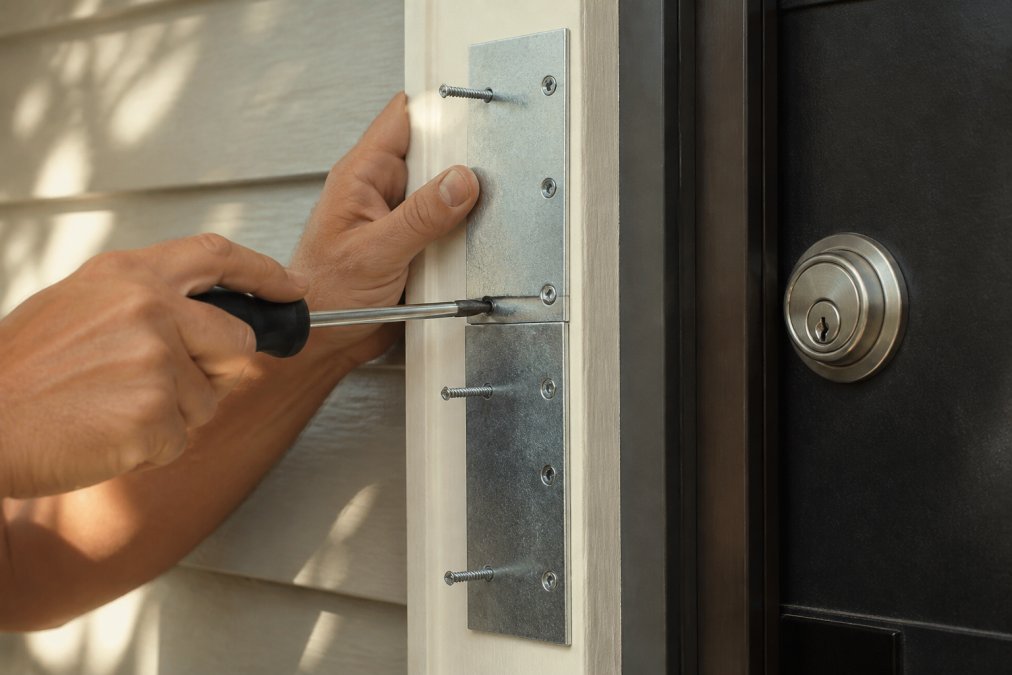
Hinge reinforcement is equally critical. Replace hinge screws with long ones that reach into the structural frame to prevent hinges from being forced out.
The Door Armor Single Door Security Set ($79.00) reinforces the strike plate and adds hinge shields with galvanized steel. Installation takes about 30 minutes and includes a $500 Lifetime Guarantee against kick-ins.
Reinforcing Door Jambs: The Critical Weak Point
The door jamb is the vertical frame piece the door closes against. Most jambs are thin wood and weak under pressure, a determined kick can split them in seconds. Yet many homeowners overlook jamb reinforcement because it's not visible once the door closes.
Reinforced door jambs use metal plates screwed into the frame that distribute force across a larger area, transferring the load from thin wood to the structural frame behind it.
Doors with side lights lack traditional jamb structure and are harder to secure. The Door Armor Side Light Door Security Kit ($129.00) uses a jamb shield and hinge shields to attach the door frame to the structural frame.
Deadbolt Locks and Strike Plate Installation
A deadbolt is only as strong as what holds it in place. Many homeowners install quality deadbolts but leave the strike plate and screws unchanged, an expensive deadbolt fails just as easily as a cheap one if the strike plate uses short screws.
Proper strike plate installation requires: replacing factory screws with long screws (3+ inches) that penetrate the structural frame, using heavy-duty metal reinforcement, and verifying proper alignment with the deadbolt.
The strike plate is where the bolt sits when locked and is the first component to fail under force. Many homeowners install a deadbolt and assume they're protected, but they've only solved half the problem. Securing entry points means securing the entire assembly: the lock, strike plate, screws, and frame.
For Renters: Non-Permanent Deadbolt Solutions
Renters face a unique challenge: landlords typically prohibit permanent modifications to doors and frames. Drilling holes for long screws or installing metal reinforcement plates violates most lease agreements. However, renters still need to secure entry points, and several non-permanent options exist that require no drilling and can be removed without damage.
A portable door lock is a wedge-shaped device that slides under the door handle, preventing the door from opening even if the lock is defeated. Cost is $15-$40 with no installation required, but it only works from the inside.
A door security bar spans the door width and distributes force across it instead of concentrating it at the lock. Adhesive-backed brackets leave no permanent marks. Cost is $30-$80, but bars are visible from inside and can be removed if an intruder gains interior access.
Temporary strike plate reinforcement uses adhesive-backed metal plates that extend the contact area and distribute force. Cost is $20-$50 per door and provides modest reinforcement without requiring screws.
For renters, combine a portable door lock (when home), a door security bar (when away), and a smart lock with keypad code (if permitted) for layered security without violating lease terms.
Maintenance Schedule for Long-Term Security
Door Armor Single Door Security Set →
Security hardware degrades over time. A seasonal maintenance schedule ensures entry point security remains effective.
Quarterly: Test deadbolts for smooth engagement, tighten loose screws on hinges and strike plates, check for rust on metal hardware, and test smart locks and sensors for battery charge and connectivity.
Semi-Annually: Inspect strike plate screws (replace if shorter than 3 inches), check door frames for cracks, inspect hinges for damage, and test motion-activated lights.
Annually: Have a locksmith inspect all exterior locks and entry points, check door condition (replace hollow-core doors if damaged), inspect frames for rot or water damage, and test the entire security system.
Securing Sliding Glass Doors Against Lift-Offs
Sliding glass doors can be lifted off their track, bypassing the lock entirely. An intruder doesn't need to break the glass or defeat the lock.
Preventing lift-offs requires a locking mechanism that prevents vertical movement. A standard sliding door lock only prevents horizontal sliding; a deadbolt-style lock physically prevents the door from being lifted.
The Armor Latch Sliding Door Deadbolt ($39.99) prevents lift-offs by engaging with the sliding door and preventing vertical movement.
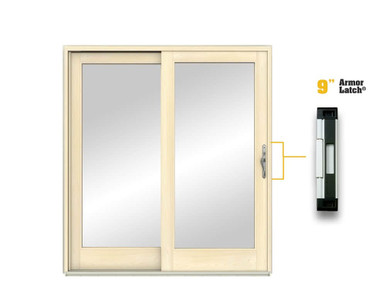
Keep sliding door tracks clean and in good condition, dirty or damaged tracks make doors easier to lift.
Smart Locks and Motion-Activated Lighting as Deterrents
Smart locks and motion-activated lighting eliminate key-based vulnerabilities and detect entry attempts in real time, something reinforced hardware alone cannot provide.
Smart locks eliminate exterior keys and allow temporary access codes for guests without changing locks. Most integrate with Amazon Alexa, Google Home, and Apple HomeKit for remote control and notifications.
Paired with a door sensor, smart locks create automated alerts. If your back door opens at 2 a.m., the system sends an immediate notification. This real-time awareness is something reinforced hardware alone cannot provide.
Motion-activated lighting deters intruders by making properties less attractive targets. Sensors should cover all entry points (front, back, side doors, garage) and be positioned 4 to 8 feet high to detect movement without false triggers from cars or animals.
Entry point sensors integrated with smart home hubs create layered detection. When a door opens in "away" mode, lights activate, a siren sounds, and an alert is sent, all in seconds.
However, smart technology has a critical limitation: it requires power and internet connectivity.
Protecting Garage and Outbuilding Entry Points
Garages and outbuildings are often overlooked in home security planning, yet they're common entry points for break-ins. A garage door can be forced open. An outbuilding door is often weaker than the main house door. Once inside a garage or shed, an intruder has access to tools and a workspace out of view.
| Entry Point | Primary Vulnerability | Reinforcement Method | Difficulty Level |
|---|---|---|---|
| Exterior hinged doors | Strike plate failure under force | Long screws + metal reinforcement | Easy |
| Door jambs | Thin wood splitting | Metal jamb shields | Easy |
| Sliding glass doors | Lift-off from track | Deadbolt-style locking mechanism | Easy |
| Garage doors | Track or spring failure | Track reinforcement + security bars | Moderate |
| Outbuildings | Weak frame and hinges | Same as exterior doors | Easy |
Frequently Asked Questions
How do most burglars gain entry into a home?
Most forced entries occur through exterior doors, particularly the front and back doors. Burglars target weak door jambs, hollow-core doors, and poorly installed strike plates because they can be kicked in within seconds. Entry through windows is less common for initial access. Securing entry points with reinforced hardware, solid-core or metal-clad doors, and proper strike plate installation significantly increases the time and effort required, often causing intruders to abandon the attempt.
What's the difference between preventing door kick-ins and general home security?
Preventing door kick-ins focuses specifically on hardening the physical weak points that allow forced entry: the door jamb, hinges, strike plate, and door frame. This is different from general home security, which includes locks, alarms, and monitoring. A door can have an excellent deadbolt but still fail under force if the jamb is weak. Reinforcing these structural vulnerabilities provides passive, always-active protection that doesn't rely on power, monitoring services, or your response time.
Can I secure sliding glass doors as effectively as hinged doors?
Sliding glass doors present a unique vulnerability because they can be lifted off their tracks by intruders. A deadbolt designed for sliding doors, like the Armor Latch Sliding Door Deadbolt, uses a heavy-duty locking mechanism to prevent this lift-off attack. While sliding doors will always be slightly less secure than solid hinged doors due to their design, proper reinforcement with the right deadbolt and security bar makes them significantly more difficult to breach than standard locks alone.
Do I need professional installation, or can I install entry point security myself?
Most door reinforcement kits, including Door Armor's solutions, are designed for DIY installation and can be completed in under 30 minutes with basic tools. The installation process involves securing strike plates, hinge shields, and jamb reinforcement components with screws into existing door frames. If you're uncertain about your installation, Door Armor provides support and a $500 Lifetime Guarantee, so you can install with confidence knowing your protection is backed by the manufacturer.