 blog
blog
Prime-Line vs Don-Jo Door Security: Which Is Better?
Table of Contents
- Prime-Line vs Don-Jo: Head-to-Head Door Security Comparison
- Understanding Door Reinforcement Kits: Components and Coverage
- Compatibility Matrix: Matching Hardware to Your Door Type
- Installation Basics for Security Hardware: DIY vs. Pro
- How to Prevent Door Kick-Ins: The Weak Points to Reinforce
- Door Armor vs Don-Jo: A Direct Head-to-Head Comparison
- Budget-Friendly Home Security Solutions: What to Buy
- Conclusion: Securing Your Door Frame Integrity
- Frequently Asked Questions
Last Updated: September 5, 2026
Prime-Line vs Don-Jo: Head-to-Head Door Security Comparison
Choosing between Prime-Line and Don-Jo for your door security upgrade comes down to a single question: are you reinforcing the lock, or the entire door frame? Prime-Line and Don-Jo are both established names in architectural hardware, but their product lines serve different threat levels. At Door Armor, we've spent over 20 years analyzing forced entry attempts, and the data consistently shows that most break-ins exploit the door frame, not the lock cylinder.
A door reinforcement kit is a system of metal plates and hardware designed to protect the weak points of an entry door against forced entry. The most common weak points are the strike plate area, the hinge side, and the door edge itself. Before you buy any security hardware, you need to identify which of these points is vulnerable on your specific door.
Direct Model Comparison: What You're Actually Buying
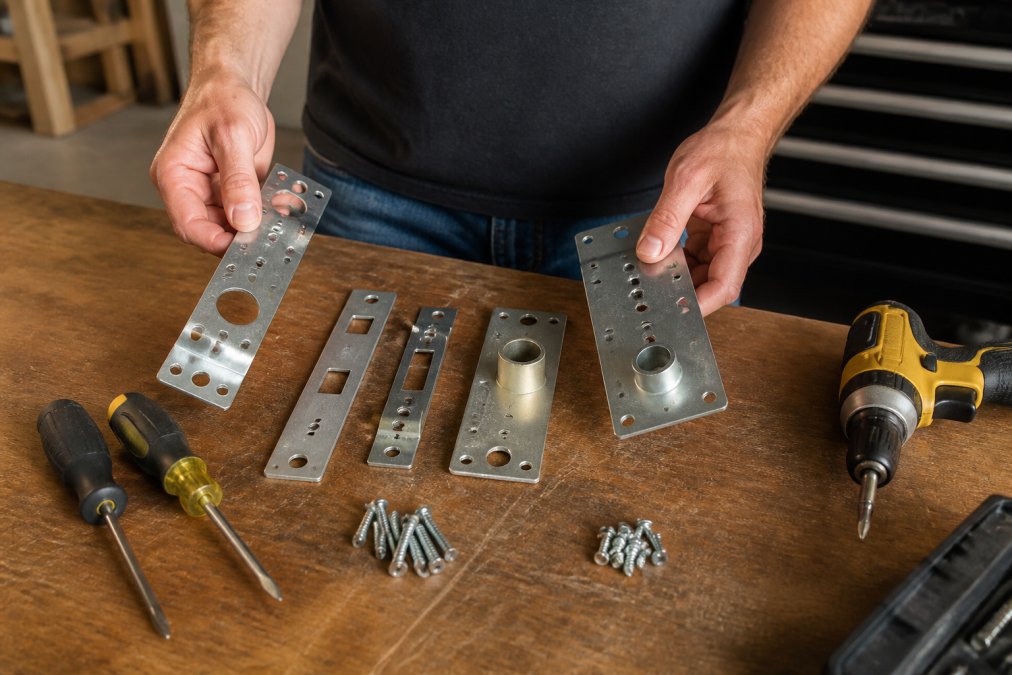
Most online comparisons stop at brand-level generalizations. To make a smart purchase, you need to compare the specific products each brand offers for the same job. Here is a side-by-side look at the most common residential upgrades from each manufacturer.
| Feature | Prime-Line (e.g., N 5054 Reinforced Strike Plate) | Don-Jo (e.g., 100 Series Strike Plate) |
|---|---|---|
| Primary Material | 16-gauge steel with a brass-plated or stainless finish | 12-gauge steel, often in a satin chrome or oil-rubbed bronze finish |
| Screw Length (Included) | 1-inch and 1.5-inch wood screws | 1-inch and 2.5-inch wood screws (some models include 3-inch) |
| Frame Profile Fit | Standard 1-1/8" to 1-3/4" frames | Standard and custom frames; requires measuring the frame depth for non-standard profiles |
| Installation Difficulty | Low; often a direct swap for a builder-grade plate | Moderate; thicker gauge may require deepening the mortise for a flush fit |
| Finish Options | Wide range (brushed nickel, oil-rubbed bronze, satin chrome, etc.) | More limited, but includes commercial-grade finishes |
This table highlights a key trade-off: Prime-Line offers easier installation and better aesthetic matching, while Don-Jo's thicker steel provides more raw material strength. But neither addresses the full jamb.
Security Rating and Force Testing: What the Numbers Don't Tell You
Neither Prime-Line nor Don-Jo publishes standardized, third-party force testing data for their residential lines. This makes direct claims about "kick-in resistance" difficult to verify. However, the physical design differences tell a clear story about intended use.
Prime-Line produces a broad catalog of replacement hardware, including latch guards and reinforced strike plates. Their products are widely available and reasonably priced, but they are typically designed as an upgrade over a builder-grade plate, not as a comprehensive door hardening solution. Don-Jo focuses specifically on strike plate manufacturing, offering thicker gauge steel options that fit standard and custom frame profiles.
A common pattern in the industry is that a 12-gauge plate (Don-Jo) will resist bending under a pry bar better than a 16-gauge plate (Prime-Line). But the failure point in a kick-in is rarely the plate itself. It is the wood of the jamb that splinters around the screws. A thicker plate only helps if the screws anchoring it are long enough to reach the structural stud behind the frame.
The critical distinction is coverage. A reinforced strike plate from either brand protects only the latch point. It does nothing for the door jamb above and below the strike, which is where many kick-ins succeed. If you are choosing between these two brands for a standard residential door, your decision should be based on frame profile fit and finish preference, not on a belief that one brand's plate will stop a determined kick.
Understanding Door Reinforcement Kits: Components and Coverage
Full door reinforcement kits address all the weak points in a single system. A complete kit typically includes a strike plate reinforcement, hinge-side protection, and a door wrap or plate that covers the area around the deadbolt.
Door security hardware falls into two categories: point-specific and full-frame. Point-specific products, like those from Prime-Line and Don-Jo, are door accessory upgrades. Full-frame systems, like the patented design from Door Armor, use galvanized steel to distribute force across the entire frame.
Latch Guards vs. Door Wraps: Which Type Do You Need?
A latch guard is a metal plate that protects the latch area from prying with a crowbar. It is an effective, low-cost addition for out-swinging door configurations where the hinge is exposed.
A latch protector or door wrap covers a larger surface area and reinforces the connection between the lock and the frame. This is the security upgrade recommended for in-swinging door entry points, which are the most common front doors in residential construction.
For the average homeowner, the decision comes down to threat assessment. If you want to increase pry resistance at a single point, a latch guard from Prime-Line is a solid, budget-friendly start. If the goal is break-in prevention that protects the entire door frame integrity, a full wrap system is the more reliable route.
Compatibility Matrix: Matching Hardware to Your Door Type
The most overlooked factor in mechanical security is compatibility. A strike plate that doesn't match your frame profile leaves gaps that compromise the entire installation. Returns on security hardware are almost always caused by a mismatch in one of three measurements: backset, frame depth, or door thickness. Here is how to measure each before you buy.
The Three Measurements That Matter
- Backset: The distance from the edge of the door to the center of the deadbolt or latch hole. Standard residential backsets are 2-3/8" or 2-3/4". Most Prime-Line and Don-Jo plates accommodate both, but you must verify the latch hole on the plate aligns with your door's backset.
- Frame Depth: The distance from the interior edge of the frame to the exterior edge. Standard wood frames are about 4-5/8" deep, but metal frames and custom millwork vary significantly. Don-Jo offers a wider range of custom frame depths; Prime-Line is primarily standard.
- Door Thickness: Standard residential doors are 1-3/8" (interior) or 1-3/4" (exterior). The strike plate lip must be deep enough to cover the gap between the door edge and the frame. A plate designed for a 1-3/4" door will sit proud on a 1-3/8" door, creating a gap that a pry bar can exploit.
Frame Material and Configuration Fit
| Door Type | Prime-Line Fit | Don-Jo Fit | Recommended Approach |
|---|---|---|---|
| Standard 2-3/8" backset, wood frame | Good | Good | Reinforced strike plate with 3-inch screws |
| Out-swinging metal frame | Limited | Good | Latch guard + hinge pin; verify frame depth for plate fit |
| In-swinging wood frame, 1-3/4" thick | Good | Good | Full door wrap system for jamb coverage |
| Custom/Commercial frame (non-standard depth) | Limited | Good | Measure frame depth; order a custom plate from Don-Jo |
| Double-door with astragal | Limited | Limited | Consider a surface-mounted bolt or full-frame reinforcement |
Prime-Line offers a wider range of finish options to match existing hardware aesthetics. Don-Jo provides more depth in custom frame sizes. Neither offers a solution that protects the full frame perimeter without additional mounting hardware.
How to Measure Your Frame Depth Correctly
A common mistake is measuring the visible trim instead of the full frame depth. To get an accurate measurement:
- Remove the existing strike plate screws and pull the plate off.
- Insert a tape measure into the mortise (the recessed area) and measure from the back of the mortise to the outer edge of the frame.
- Compare this number to the specifications on the product packaging. If the plate is too shallow, the latch will not engage fully. If it is too deep, the plate will sit proud and create a pry point.
In-Swinging vs. Out-Swinging Door Security
In-swinging doors are vulnerable at the strike plate because the door opens toward the interior, allowing a kick to push the door into the frame. Out-swinging doors are vulnerable at the hinges, which are accessible from the exterior.
For in-swinging doors, the priority is deep-penetrating screws and a reinforced strike area. For out-swinging doors, the priority shifts to hinge-side protection and latch guards that prevent the door from being spread away from the frame.
Many homeowners in high-crime areas ask whether a steel security door eliminates the need for interior reinforcement. A steel door is only as strong as the frame it is mounted in. If the frame is builder-grade wood, a determined kick can still compromise the door jamb.
Installation Basics for Security Hardware: DIY vs. Pro
Most door reinforcement products are designed for DIY installation. A basic strike plate swap takes about 15 minutes with a screwdriver. A full installation kit with a door wrap typically takes under 30 minutes for a competent homeowner.
The primary challenge is alignment. If the new plate does not sit flush with the latch, the door may not close properly. This is a common issue with thicker gauge steel plates that require the mortise (the recess in the frame) to be deepened.
For renters, a key concern is reversibility. Some reinforcement systems require drilling into the frame, which may violate a lease. A few products, including Door Armor, are designed to be installed with minimal permanent modification, allowing you to take the protection with you when you move.
How to Prevent Door Kick-Ins: The Weak Points to Reinforce
How to prevent door kick-ins starts with understanding that the lock is rarely the failure point. A kick-in attack aims to break the frame, not the lock. The force of the kick is concentrated at the strike plate and the jamb.
The most effective defense is a system that transfers that force away from the jamb and into the structural studs. This requires:
- A reinforced strike plate with 3-inch screws
- A metal wrap that covers the deadbolt area
- Hinge-side reinforcement for out-swinging doors
A common misconception is that a heavy-duty deadbolt is sufficient. The deadbolt is only as strong as the strike plate it locks into. If the strike plate pulls out of the frame, the deadbolt is useless. This is why the best door reinforcement kits focus on the frame, not the lock mechanism.
Door Armor vs Don-Jo: A Direct Head-to-Head Comparison
When comparing full door security systems, Door Armor is designed for a different outcome than Don-Jo. Don-Jo provides excellent replacement strike plates for specific frame profiles. Door Armor provides a complete door hardening system that addresses the entire entry point.
Door Armor's patented galvanized steel system is police-tested and recommended, with a $500 Lifetime Guarantee against kick-ins. It is installed by homeowners in under 30 minutes and is designed to match your existing hardware, so it does not look like a commercial-grade fortress.
The real difference comes down to coverage. A Don-Jo strike plate protects a 4-inch section of the frame. A Door Armor system protects the full perimeter of the lock area, distributing the force of a kick across multiple structural points.
Budget-Friendly Home Security Solutions: What to Buy
For homeowners on a budget, the priority should be the strike plate screws. Replacing the factory 1-inch screws with 3-inch screws is a $5 upgrade that significantly improves door frame integrity. This is the highest-impact, lowest-cost change you can make.
A reinforced strike plate from Prime-Line or Don-Jo is the next step, typically costing a modest amount more than a builder-grade plate. These are smart upgrades for residential security and are widely available at hardware stores.
For comprehensive protection, a full-frame reinforcement system represents a higher upfront investment but eliminates the need for multiple point-specific products. When comparing costs, factor in the value of your time and the potential property damage from a successful break-in. Door Armor's system is designed to stop forced entry attempts at the frame, where most attacks succeed.
Conclusion: Securing Your Door Frame Integrity
The choice between Prime-Line and Don-Jo is really a choice between incremental upgrades and comprehensive protection. Prime-Line offers accessible, general-purpose hardware. Don-Jo provides specialized strike plates. Both improve specific weak points, but neither alone secures the full frame.
For the strongest defense against kick-ins, you need a system that reinforces the entire entry point, not just the latch. Door Armor's patented galvanized steel design, backed by a $500 Lifetime Guarantee, is the most reliable way to secure your door frame integrity and protect your family. Get started with Door Armor and secure your doors in under 30 minutes.
Frequently Asked Questions
What is the main difference between Prime-Line and Don-Jo door security products?
The main difference lies in their approach to door reinforcement. Prime-Line offers a broad range of replacement parts and individual components like latch guards and strike plates. Don-Jo specializes in heavy-duty, wrap-around style door reinforcers that cover the entire lock and latch area. For complete protection against kick-ins, a full wrap system like those from Don-Jo or Door Armor covers more of the door's weak points than a simple latch guard.
Are Don-Jo door reinforcers effective against kick-ins?
Yes, Don-Jo door reinforcers are designed to address the most common failure points during a forced entry attempt. By wrapping the door edge and securing the strike plate with longer screws into the door frame, they add significant pry resistance and door frame integrity. However, for maximum protection, look for systems that reinforce the door frame itself, as the frame, not just the door, is often what gives way during a kick-in.
How do I choose between a latch guard and a door wrap for home security?
Choose a latch guard if you want a simple, low-profile fix to prevent someone from using a tool to pry the latch back. Choose a full door wrap if you need more comprehensive security that reinforces the entire lock area and adds deadbolt reinforcement. A wrap is a good choice for high-traffic rental properties or doors that have sustained previous damage, as it covers more surface area and provides a more rigid barrier against forced entry.
Are there better alternatives to Prime-Line and Don-Jo for door reinforcement?
Yes, there are alternatives that offer a more complete security solution. While Prime-Line and Don-Jo sell hardware components, systems like Door Armor use a patented, galvanized steel design that reinforces the door frame, hinges, and strike plate together. This addresses the structural weakness of the frame itself, which is where most kick-ins succeed. Door Armor is police-recommended and comes with a lifetime guarantee, making it a more comprehensive choice for whole-door hardening.
Frequently Asked Questions
Q: What is the main difference between Prime-Line and Don-Jo door security products?
A: The main difference lies in their approach to door reinforcement. Prime-Line offers a broad range of replacement parts and individual components like latch guards and strike plates. Don-Jo specializes in heavy-duty, wrap-around style door reinforcers that cover the entire lock and latch area. For complete protection against kick-ins, a full wrap system like those from Don-Jo or Door Armor covers more of the door's weak points than a simple latch guard.
Q: Are Don-Jo door reinforcers effective against kick-ins?
A: Yes, Don-Jo door reinforcers are designed to address the most common failure points during a forced entry attempt. By wrapping the door edge and securing the strike plate with longer screws into the door frame, they add significant pry resistance and door frame integrity. However, for maximum protection, look for systems that reinforce the door frame itself, as the frame, not just the door, is often what gives way during a kick-in.
Q: How do I choose between a latch guard and a door wrap for home security?
A: Choose a latch guard if you want a simple, low-profile fix to prevent someone from using a tool to pry the latch back. Choose a full door wrap if you need more comprehensive security that reinforces the entire lock area and adds deadbolt reinforcement. A wrap is a good choice for high-traffic rental properties or doors that have sustained previous damage, as it covers more surface area and provides a more rigid barrier against forced entry.
Q: Are there better alternatives to Prime-Line and Don-Jo for door reinforcement?
A: Yes, there are alternatives that offer a more complete security solution. While Prime-Line and Don-Jo sell hardware components, systems like Door Armor use a patented, galvanized steel design that reinforces the door frame, hinges, and strike plate together. This addresses the structural weakness of the frame itself, which is where most kick-ins succeed. Door Armor is police-recommended and comes with a lifetime guarantee, making it a more comprehensive choice for whole-door hardening.