 comparison
Is Steel Door Security Worth It? 2026 Guide
Table of Contents
- Steel Door Security: What You're Actually Buying
- How Steel Door Reinforcement Stops Forced Entry
- Steel vs. Fiberglass vs. Wood: Security Comparison
- Choosing the Right Door Reinforcement Kits for Your Home
- Installation Integrity and Long-Term Performance
- Insurance Savings and Real-World Break-In Prevention
- Is Steel Door Security Worth the Investment?
Last Updated: August 22, 2026
Steel Door Security: What You're Actually Buying
When someone kicks at your front door, you have seconds. That's the reality that drives the entire conversation around steel door security worth it. The question isn't whether steel doors stop intruders, they do. The real question is whether the investment makes sense for your specific situation, your budget, and your actual risk profile.
Door Armor has spent over 20 years analyzing how doors fail during forced entry attempts. What we've learned changes how you should think about steel door security. Most homeowners focus on the door itself, but the weak points are actually the frame, hinges, and strike plate. A standard wooden door frame can splinter under pressure, regardless of how solid the door is. That's where reinforcement systems come in, they address the vulnerabilities that doors alone cannot fix.
This guide breaks down whether steel door security is worth it for your home. We'll examine how reinforcement actually stops forced entry, compare steel against other materials, walk through installation and long-term performance, and address the financial question directly: does this investment pay for itself through insurance savings and break-in prevention?
How Steel Door Reinforcement Stops Forced Entry
Steel door reinforcement works by distributing force across a wider area of the frame, preventing the concentrated stress that causes wooden frames to fail. When someone attempts a kick-in, the force concentrates at the deadbolt strike plate. A standard wooden jamb splinters under this pressure in seconds (peer-reviewed research). Steel reinforcement kits use galvanized steel shields that attach to the frame, strike plate, and hinges, spreading that force across the structural components rather than letting it concentrate on a single weak point.
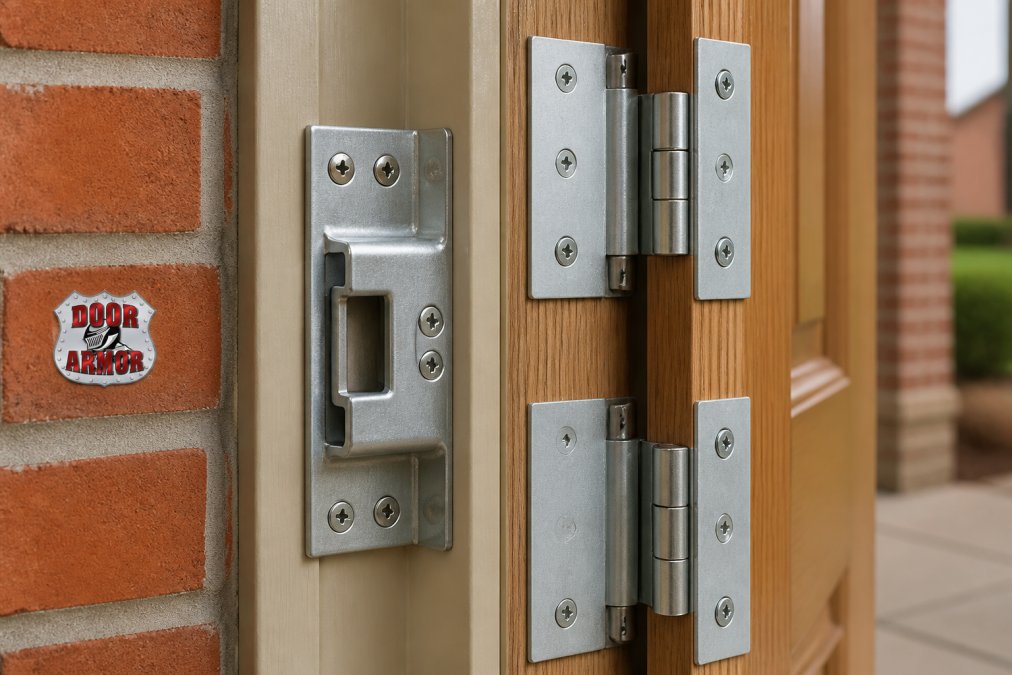
The Door Armor approach uses patented galvanized steel shielding that covers the strike plate area and extends up and down the jamb. This prevents the classic kick-in failure mode where the door frame separates from the wall. Hinge shields add another layer, they prevent someone from simply removing the hinges and lifting the door off its frame. When you combine strike plate reinforcement with hinge protection and door jamb shielding, you create what security professionals call "structural integrity" at the entry point.
Door reinforcement kits also address prying attacks. A standard door frame has gaps where a pry bar can be inserted. Reinforcement systems close these gaps and create a continuous barrier that prevents use attacks. The galvanized steel construction resists corrosion, meaning the system maintains its integrity through years of weather exposure and temperature cycling.
Most reinforcement systems install in under 30 minutes using basic tools (the CDC). The Door Armor Single Door Security Set costs $79.00 and provides a $500 lifetime guarantee against kick-ins. For doors with side lights, where there's no structural jamb to reinforce, the Door Armor Side Light Door Security Kit ($129.00) uses a different approach, screwing directly into the door frame face to create the necessary rigidity. Double doors present their own challenge since there's no center jamb; the Door Armor Double Door Security Kit ($149.00) includes a night lock door barricade for maximum security.
Steel vs. Fiberglass vs. Wood: Security Comparison
The door material itself matters less than most people think. What actually matters is the frame reinforcement and how the door connects to that frame. That said, material does influence overall durability and weather resistance.
| Material | Break-In Resistance | Weather Durability | Maintenance | Cost Range | Best For |
|---|---|---|---|---|---|
| Steel | Excellent | Excellent | Low | $400-$1,200 | Maximum security, any climate |
| Fiberglass | Good | Excellent | Low | $300-$900 | Aesthetic appeal with decent security |
| Wood | Fair | Poor | High | $200-$600 | Traditional homes, lower priority areas |
Steel doors offer superior impact resistance and don't splinter or crack under force. Fiberglass doors provide good security while maintaining a traditional appearance and better insulation properties than wood. Wood doors look authentic but offer minimal forced entry protection without reinforcement.
Here's where most guides get this wrong: a fiberglass or wood door with proper frame reinforcement provides nearly identical forced entry protection to a steel door with reinforcement. The door material becomes secondary to the frame integrity. What changes is durability and maintenance. Steel requires occasional touch-ups to prevent corrosion in coastal climates. Fiberglass and wood need regular maintenance to prevent warping, rot, and weather damage.
For energy efficiency, fiberglass and wood doors with proper insulation cores outperform steel doors. Steel conducts temperature, creating thermal bridging where cold transfers through the door frame into your home. This is why many homeowners choose fiberglass doors with steel frame reinforcement kits, you get the appearance and insulation benefits of fiberglass plus the security of reinforced framing.
The cost-effectiveness calculation shifts based on your climate and maintenance tolerance. In humid or coastal climates, steel requires more maintenance. In cold climates, the thermal bridging becomes noticeable. In stable climates, steel doors with reinforcement offer the best combination of security and longevity.
Choosing the Right Door Reinforcement Kits for Your Home
Door reinforcement comes in several configurations depending on your entry point type. Standard single doors, side-light doors, sliding glass doors, and double doors each require different solutions. Your first decision is whether you're replacing the entire door or reinforcing what you have.
Reinforcement kits work on existing doors and frames. They're designed for homeowners who don't want to replace their door but need to address forced entry vulnerabilities. The Door Armor Single Door Security Set fits standard single entry doors up to 1-3/4 inches thick. It includes strike plate shields, hinge shields, and door jamb reinforcement. Installation requires only a drill and screwdriver.
Side-light doors, where glass panels flank the main door, present a unique challenge because there's no solid jamb to reinforce. The Door Armor Side Light Door Security Kit solves this by screwing directly into the door frame face, creating structural rigidity where none exists. This is critical because standard reinforcement won't work on doors with side lights; you need a system designed specifically for that configuration.
Double doors create another problem: no center jamb means no natural reinforcement point. The Door Armor Double Door Security Kit includes a night lock barricade system that secures both doors simultaneously. This prevents the common failure mode where one door panel is forced inward, creating use to break the lock.
The installation process matters more than people realize. A poorly installed reinforcement kit won't perform as intended. Door Armor kits are designed for DIY installation with clear instructions and pre-drilled mounting points. However, some homeowners prefer professional installation to ensure proper alignment and structural integrity. If you go this route, expect installation costs of $150-$300 on top of the kit price.
When choosing a kit, consider your specific vulnerabilities. Are you protecting against kick-ins, prying attacks, or both? Do you have side lights or double doors? Is your door frame solid wood or composite? These factors determine which kit provides the best protection for your situation.
Installation Integrity and Long-Term Performance
Installation quality determines whether your reinforcement system actually stops forced entry. A perfectly designed system installed incorrectly becomes a false sense of security. This is where many homeowners make mistakes.
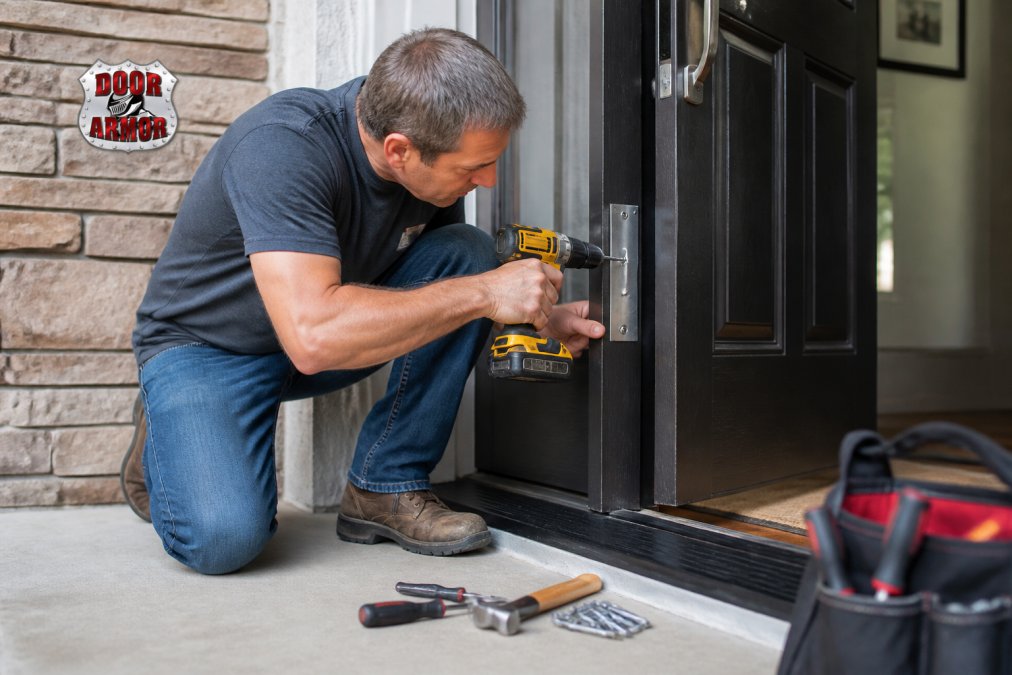
The critical installation points are strike plate alignment, hinge shield positioning, and door jamb attachment. The strike plate shield must align perfectly with the deadbolt to prevent the lock from being bypassed. Hinge shields must be positioned so they cover the hinge pin completely, preventing removal attacks. Door jamb reinforcement must be attached securely to the frame's structural members, not just the surface.
Door Armor kits come with pre-drilled holes and detailed instructions to ensure proper alignment. The 30-minute installation time assumes someone with basic tool skills. If you're uncomfortable with drilling into your door frame or aligning components precisely, professional installation is worth the cost.
Long-term performance depends on material quality and climate conditions. Galvanized steel resists corrosion but can develop surface rust in coastal climates or areas with heavy salt exposure. Powder coating adds another layer of protection and improves aesthetics. Over 10-15 years, a well-installed reinforcement system should require minimal maintenance, occasional cleaning and perhaps reapplication of protective coating in harsh climates.
The structural integrity of your door frame matters. If your frame is already compromised by rot, settling, or previous damage, reinforcement alone won't solve the problem. You may need frame repair before installation. This is why professional installers often recommend a pre-installation inspection.
Insurance Savings and Real-World Break-In Prevention
Here's where the financial case for steel door security becomes concrete. Insurance companies recognize that proper door reinforcement reduces break-in risk. Many homeowners don't realize they can get discounts on their homeowners insurance by upgrading security measures.
Insurance discounts for security upgrades can vary by carrier and your current coverage. Over five years, a Door Armor Single Door Security Set, which costs $79.00, can potentially pay for itself through insurance savings alone.
Beyond insurance, there's the prevention value. Break-ins cost homeowners thousands in property damage, stolen goods, and emotional aftermath. A reinforced door that prevents entry entirely eliminates these costs. Police departments consistently report that visible security measures, reinforced frames, security signage, visible hardware, deter burglars (fbi.gov). Burglars target homes that appear easy to breach. A reinforced door frame signals that you've taken security seriously.
The real-world effectiveness data comes from police departments that have tested reinforcement systems. Door Armor has been tested by law enforcement and recommended by police departments across the country. The system has a track record of stopping forced entry attempts that would succeed against standard doors and frames.
For rental properties and vacation homes, the case is even stronger. Unoccupied properties face higher break-in risk. A reinforced door system provides passive security that requires no power, no monitoring service, and no active management. It works 24/7 whether the property is occupied or empty.
Is Steel Door Security Worth the Investment?
The answer depends on your situation. For homeowners in areas with elevated crime rates, the investment is clearly worth it. For those with previous break-in experience, reinforcement addresses the specific vulnerabilities that allowed entry before. For rental property owners managing vacant units, the passive security and insurance benefits make the investment economical.
The cost-benefit calculation is straightforward: a $79-$149 reinforcement kit, installed in 30 minutes, provides $500 lifetime protection against kick-ins, potential insurance discounts, and elimination of the risk of break-in damage and loss. Even if you never experience a break-in attempt, the insurance savings alone justify the investment.
The alternative, replacing your entire door and frame, costs $1,500-$3,000 installed. A reinforcement kit provides 80% of the security benefit at 5% of the cost. For most homeowners, that's the rational choice.
What makes reinforcement systems genuinely valuable is that they address the actual weak points in residential security. The door itself is rarely the problem. The frame, strike plate, hinges, and jamb are where doors fail. A reinforcement system fixes these vulnerabilities without replacing functional doors that may be perfectly adequate aesthetically and functionally.
The durability question matters if you're evaluating this as a long-term investment. Galvanized steel reinforcement systems maintain their integrity for 15+ years with minimal maintenance. They don't require power, monitoring, or active management. They improve with age in the sense that they become more valuable as weather exposure and settling test their structural integrity, and they pass that test consistently.
Steel door security is worth the investment if you want to eliminate forced entry as a realistic threat to your home. The combination of affordability, effectiveness, and ease of installation makes reinforcement systems the practical choice for most homeowners. Door Armor's patented system, with its $500 lifetime guarantee and police testing, provides the confidence that your investment actually delivers on its promise. For homeowners serious about entry-point security, reinforcement kits represent the best return on security investment available today.
Frequently Asked Questions
Q: Are steel door security systems actually effective at stopping break-ins?
A: Steel door security reinforcement works by strengthening the weakest points where forced entry typically occurs: the strike plate, door jamb, and hinges. Systems like Door Armor use galvanized steel components that resist prying and kick-ins. The effectiveness depends on proper installation and covering all vulnerable entry points. Police-tested systems with a $500 lifetime guarantee indicate manufacturers stand behind their break-in resistance claims, though no system is 100% burglar-proof.
Q: How much can door reinforcement kits actually improve security compared to a standard deadbolt?
A: A standard deadbolt alone protects only the lock mechanism. Door reinforcement kits address the structural vulnerabilities: thin door jambs that splinter under force, hinges that can be pried off, and strike plates that pull away from the frame. By reinforcing the entire door frame and adding hinge security, these kits extend the time and force required to breach an entry, buying critical seconds to call for help or prepare a response.
Q: If I already have a steel security door on my front entrance, do I still need door reinforcement for other doors?
A: Yes. Burglars target the easiest entry point. If your front door is fortified but your back door, side door, or sliding glass door remains weak, those become prime targets. Many break-ins occur through less obvious entries like side doors or basement doors. Reinforcing all exterior entry points eliminates the weak links and forces intruders to spend more time and effort, increasing the likelihood they'll abandon the attempt.
Q: How do I know which door reinforcement kit is right for my home?
A: Consider your door types: single standard doors, double doors, doors with side lights, or sliding glass doors each have different vulnerabilities. Standard single doors typically need a basic security kit ($79). Doors with side lights require specialized jamb shields ($129) because they lack a solid center jamb. Double doors need additional reinforcement at the bottom and center ($149). Measure your door thickness and identify which entry points concern you most to select the appropriate kit.
Q: Will steel door security hardware look obvious or make my home look like a fortress?
A: Quality door reinforcement systems are designed to blend with existing hardware. Components like hinge shields and strike plate reinforcements come in finishes like satin nickel that match standard door hardware. Installation is discreet, shields attach to the door frame and hinges without drawing attention. Unlike installing a full steel security door, reinforcement kits strengthen security without changing your home's appearance or curb appeal.
This article was written using GrandRanker
Frequently Asked Questions
Q: Are steel door security systems actually effective at stopping break-ins?
A: Steel door security reinforcement works by strengthening the weakest points where forced entry typically occurs: the strike plate, door jamb, and hinges. Systems like Door Armor use galvanized steel components that resist prying and kick-ins. The effectiveness depends on proper installation and covering all vulnerable entry points. Police-tested systems with a $500 lifetime guarantee indicate manufacturers stand behind their break-in resistance claims, though no system is 100% burglar-proof.
Q: How much can door reinforcement kits actually improve security compared to a standard deadbolt?
A: A standard deadbolt alone protects only the lock mechanism. Door reinforcement kits address the structural vulnerabilities: thin door jambs that splinter under force, hinges that can be pried off, and strike plates that pull away from the frame. By reinforcing the entire door frame and adding hinge security, these kits extend the time and force required to breach an entry, buying critical seconds to call for help or prepare a response.
Q: If I already have a steel security door on my front entrance, do I still need door reinforcement for other doors?
A: Yes. Burglars target the easiest entry point. If your front door is fortified but your back door, side door, or sliding glass door remains weak, those become prime targets. Many break-ins occur through less obvious entries like side doors or basement doors. Reinforcing all exterior entry points eliminates the weak links and forces intruders to spend more time and effort, increasing the likelihood they'll abandon the attempt.
Q: How do I know which door reinforcement kit is right for my home?
A: Consider your door types: single standard doors, double doors, doors with side lights, or sliding glass doors each have different vulnerabilities. Standard single doors typically need a basic security kit ($79). Doors with side lights require specialized jamb shields ($129) because they lack a solid center jamb. Double doors need additional reinforcement at the bottom and center ($149). Measure your door thickness and identify which entry points concern you most to select the appropriate kit.
Q: Will steel door security hardware look obvious or make my home look like a fortress?
A: Quality door reinforcement systems are designed to blend with existing hardware. Components like hinge shields and strike plate reinforcements come in finishes like satin nickel that match standard door hardware. Installation is discreet—shields attach to the door frame and hinges without drawing attention. Unlike installing a full steel security door, reinforcement kits strengthen security without changing your home's appearance or curb appeal.