 how-to
How to Stop Door Kick-Ins: 7 Steps to Secure Your Home
Table of Contents
- Why Door Kick-Ins Are Your Home's Biggest Security Risk
- How to Reinforce Front Door Frame for Maximum Protection
- Door Strike Plate Reinforcement: The First Line of Defense
- Best Door Security Devices for Home Protection
- Step-by-Step Installation Guide for Door Reinforcement
- Testing and Maintenance: Keep Your Doors Secure
- Rental-Friendly Security Solutions for Temporary Protection
- Conclusion
- Frequently Asked Questions
Last Updated: September 3, 2026
Why Door Kick-Ins Are Your Home's Biggest Security Risk
Door kick-ins remain the most common method burglars use to gain entry. A forced entry through a door takes seconds when the frame, jamb, or strike plate fails under pressure. Standard door frames, hollow-core doors, and basic strike plates are engineered for convenience, not security. When someone applies force, the weakest component gives way first, usually the strike plate, fastened with short screws that barely penetrate the frame.
Reinforcing your entry doors buys critical time: time to call for help, reach safety, or activate an alarm. Your front and back doors are the entry points burglars target first. Securing them properly is essential to protect your family and property.
How to Reinforce Front Door Frame for Maximum Protection
Reinforcing your front door frame is the foundation of any serious security strategy. The frame's strength depends on its fasteners and how they connect to your home's structure.
Strengthen the Door Jamb and Frame
The door jamb, the vertical piece holding your hinges and strike plate, is typically soft wood that splinters easily under force. Upgrading to longer screws, at least 3 inches, that penetrate through the jamb and into the structural framing creates a connection far more resistant to kick-ins than standard hardware.
A reinforcement kit designed for this purpose adds galvanized steel components that distribute force across a wider area of the jamb, spreading impact load rather than concentrating pressure on a single strike plate. Ensure your door frame sits flush against the structural opening with no gaps between frame and wall.
Install Hinge Shields
Door hinges take the brunt of kicking force and are often secured with short screws that don't penetrate the structural frame. Hinge shields are metal plates that extend fastening depth by requiring longer screws reaching deep into the frame's structural components. They also prevent prying attacks.
Installing hinge shields requires replacing existing hinge screws with longer ones (typically 3-inch screws) that pass through the hinge, shield, jamb, and into structural framing. Reinforce all visible hinges to distribute load and prevent attackers from targeting a single weak point.
Door Strike Plate Reinforcement: The First Line of Defense
The strike plate is the metal component on the jamb that the door latch enters when closed. Standard strike plates are held by two short screws (usually 0.75 inches) that barely penetrate the jamb and don't reach structural framing. When force is applied, the strike plate pulls away and the door swings open.
A reinforced strike plate uses longer screws (typically 3 inches or more) that pass through the jamb and deep into structural framing. Some systems use multiple screw holes to distribute load across a larger area. The plate itself should be hardened steel with a larger surface area to spread force more effectively across the jamb.
Installation requires drilling new holes in the jamb. A quality reinforcement kit matches your existing hardware finish so it looks intentional rather than like a security retrofit.
Best Door Security Devices for Home Protection
Beyond reinforcing the structure, you can add hardware devices that provide additional protection against forced entry.
Deadbolt Locks and Long Screws
A deadbolt lock doesn't retract under pressure, unlike a spring latch. A quality deadbolt with a long throw (bolt extends at least 1 inch into the strike plate) resists prying and manipulation. The key to effectiveness is installation: upgrade to 3-inch screws that penetrate deep into the frame.
A deadbolt alone isn't sufficient, it must be paired with a reinforced strike plate and proper door frame reinforcement.
Door Security Bars and Three-Point Locking Systems
A door security bar is a portable device that prevents forced entry by resting against the door and floor at an angle. These work well for temporary protection and interior doors, and are popular in rental situations.
Three-point locking systems lock the door at the top, middle, and bottom, distributing load across multiple connection points. Rather than relying on a single strike plate, these systems engage the frame at multiple heights, making forced entry much harder.
Step-by-Step Installation Guide for Door Reinforcement
Installing door reinforcement hardware is a DIY-friendly project most homeowners can complete in 30 minutes.
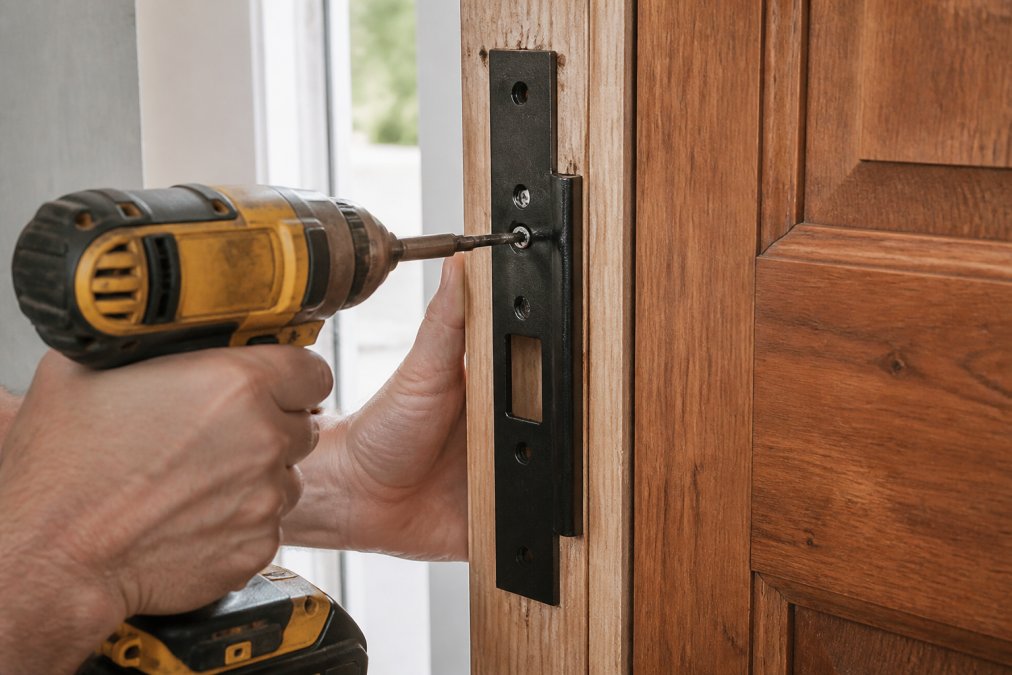
What You'll Need Before Starting
Gather these tools and materials:
- A cordless drill or screwdriver
- A tape measure
- A pencil for marking
- The door reinforcement kit (strike plate, hinge shields, and long screws)
- A level (optional)
- Safety glasses
Check your door thickness before purchasing a kit. Most residential doors are 1.75 inches thick, but some are 1.375 inches. Verify yours matches the product specifications.
Installation Steps for Single Doors
Step 1: Remove the existing strike plate. Use your drill or screwdriver to remove the old screws. Clean any debris from the jamb.
Step 2: Install the reinforced strike plate. Position the new strike plate to align with the door latch. Mark screw holes with a pencil. Drill pilot holes if required. Insert long screws through the strike plate, jamb, and into structural framing. Tighten firmly.
Step 3: Replace hinge screws. Remove one screw at a time from each hinge and replace it with a long screw from your kit, starting with the top hinge to prevent sagging. If your kit includes hinge shields, install those before inserting new screws.
Step 4: Test the door. Close the door and verify it latches smoothly. Open and close it several times. The door should feel solid with no rattling or frame movement.
Installation Steps for Double Doors and Side Light Doors
For double doors, one door (the active door) has hinges and a lock. The other (the inactive door) is secured at top and bottom with bolts. Reinforce the active door's hinges and strike plate, plus secure the inactive door's connection points with long screws.
For side light doors, use a specialized kit that works with the actual structure you have, typically using screws that penetrate through the door frame's face to create a solid connection.
Testing and Maintenance: Keep Your Doors Secure
Test your door's security monthly by applying firm pressure to verify the frame doesn't move and the door doesn't rattle. If you feel movement, check that all screws are tight.
Inspect hardware twice yearly for rust or corrosion, especially in humid or coastal environments. Check the door frame for cracks or damage. Small cracks are usually not a problem, but large splits may compromise reinforcement integrity. Test locks regularly, a deadbolt should turn smoothly and extend fully.
| Maintenance Task | Frequency | What to Check |
|---|---|---|
| Test door security with firm pressure | Monthly | Frame movement, rattling, smooth operation |
| Inspect hardware for rust or corrosion | Twice yearly | Galvanized coating, metal discoloration |
| Check door frame for cracks or splits | Twice yearly | Structural damage around screw holes |
| Verify locks operate smoothly | Monthly | Deadbolt extension, smooth turning |
| Tighten all screws | As needed (typically 1-2 times yearly) | Screw tightness after seasonal shifts |
Rental-Friendly Security Solutions for Temporary Protection
If you rent, you can't install permanent reinforcements. Portable door security bars work well in rental situations, they rest against the door and floor, creating a physical barrier without damaging the structure. They're removable and work on any standard door, but only protect when you're home to deploy them.
Talk to your landlord about installing a reinforced strike plate and upgrading hinge screws. Many landlords allow these improvements because they benefit the property without causing damage. If your landlord approves, install a proper reinforcement kit. If they don't, focus on a high-quality deadbolt, good frame condition, and a portable security bar.
Conclusion
Protecting your home from forced entry starts with understanding where doors fail and reinforcing those weak points. A reinforced door frame, upgraded strike plate, secured hinges, and quality locks create multiple barriers that stop door kick-ins before they happen. The investment in proper reinforcement pays for itself through peace of mind and protection of your family and property.
Door Armor's patented reinforcement system addresses all vulnerabilities: the strike plate, hinges, and door frame. With galvanized steel components, long structural screws, and a design matching your existing hardware, it provides the protection you need without looking like a fortress. The 30-minute installation means you don't need a contractor, and the $500 Lifetime Guarantee backs your investment. Get started with Door Armor and add the security layer your home deserves.
Frequently Asked Questions
Q: How can I prevent my door from being kicked in?
A: The most effective way to stop door kick-ins is to reinforce the door frame, strike plate, and hinges with hardened steel components. Install long screws (at least 3 inches) through the strike plate into the door jamb, add hinge shields to prevent prying, and consider a reinforcement kit that covers all vulnerable entry points. These measures work together to distribute force across the frame rather than concentrating it on a single weak point, making forced entry significantly more difficult.
Q: What is the most vulnerable part of a door frame?
A: The strike plate area is the weakest point on most doors. When force is applied during a kick-in attempt, pressure concentrates on the strike plate and the short screws (typically 1 inch) that hold it to the door jamb. The door frame itself, particularly hollow-core construction, also fails quickly without reinforcement. By upgrading to long screws and adding a reinforcement kit, you transfer the impact load across a much larger area of the structural frame, dramatically increasing resistance to forced entry.
Q: Can I install door reinforcement myself, or do I need professional help?
A: Most homeowners can install door reinforcement hardware themselves in under 30 minutes with basic tools like a drill and screwdriver. The process involves removing your existing strike plate, drilling new holes with longer screws, and installing hinge shields and reinforcement plates. Follow the manufacturer's instructions carefully, and test the door after installation to ensure proper alignment.
Q: Will door reinforcement work on rental properties or apartments?
A: Door reinforcement kits designed for renters use non-permanent installation methods that don't damage walls or frames. Portable door security bars, wedge-style door jammers, and temporary reinforcement plates can provide protection without modifications that violate lease agreements. For more permanent solutions on rentals, check with your landlord first, as many allow security upgrades that don't involve structural changes. Always remove temporary devices when you move to avoid security deposits being withheld.
This article was written using GrandRanker
Frequently Asked Questions
Q: How can I prevent my door from being kicked in?
A: The most effective way to stop door kick-ins is to reinforce the door frame, strike plate, and hinges with hardened steel components. Install long screws (at least 3 inches) through the strike plate into the door jamb, add hinge shields to prevent prying, and consider a reinforcement kit that covers all vulnerable entry points. These measures work together to distribute force across the frame rather than concentrating it on a single weak point, making forced entry significantly more difficult.
Q: What is the most vulnerable part of a door frame?
A: The strike plate area is the weakest point on most doors. When force is applied during a kick-in attempt, pressure concentrates on the strike plate and the short screws (typically 1 inch) that hold it to the door jamb. The door frame itself, particularly hollow-core construction, also fails quickly without reinforcement. By upgrading to long screws and adding a reinforcement kit, you transfer the impact load across a much larger area of the structural frame, dramatically increasing resistance to forced entry.
Q: Can I install door reinforcement myself, or do I need professional help?
A: Most homeowners can install door reinforcement hardware themselves in under 30 minutes with basic tools like a drill and screwdriver. The process involves removing your existing strike plate, drilling new holes with longer screws, and installing hinge shields and reinforcement plates. Follow the manufacturer's instructions carefully, and test the door after installation to ensure proper alignment.
Q: Will door reinforcement work on rental properties or apartments?
A: Door reinforcement kits designed for renters use non-permanent installation methods that don't damage walls or frames. Portable door security bars, wedge-style door jammers, and temporary reinforcement plates can provide protection without modifications that violate lease agreements. For more permanent solutions on rentals, check with your landlord first, as many allow security upgrades that don't involve structural changes. Always remove temporary devices when you move to avoid security deposits being withheld.