 how-to
Easy Door Reinforcement for Beginners: A Step-by-Step Guide
Table of Contents
- Why Door Reinforcement Matters for Your Home
- Understanding Door Vulnerabilities: Where Break-Ins Happen
- How to Prevent Door Kick-Ins: The Hardware That Works
- DIY Door Reinforcement Kit Installation: What You Need
- Best Door Security for Renters: Non-Destructive Options
- Common Mistakes to Avoid During Installation
- Maintenance and Long-Term Protection
- Conclusion
Last Updated: August 30, 2026
Why Door Reinforcement Matters for Your Home
Most residential break-ins exploit the weakest point of entry: the door frame and strike plate. When someone kicks a door, the force concentrates on a small area, and standard hardware simply doesn't hold. Door Armor has spent over two decades analyzing break-in patterns and learned that the difference between a door that fails and one that holds comes down to hardware. A standard strike plate uses short screws that grip only the door frame's outer veneer; when force is applied, those screws pull free. Reinforcement anchors deep into the structural framing behind the door.
Easy door reinforcement for beginners is designed to be installed in under 30 minutes without professional help, permanent damage, or specialized tools.
Understanding Door Vulnerabilities: Where Break-Ins Happen
Most doors fail at the strike plate, the small metal plate screwed to the door frame where the deadbolt latch sits. When someone applies force, the entire impact transfers through the latch into the strike plate. If screws only go into the outer frame, they'll pull free under pressure.
The second vulnerability is the door frame itself. Many homes have hollow-core interior framing or thin exterior walls that can't support the impact of a kick. Hinges present a third weakness, especially on outward-opening doors, exposed hinge pins can be removed from outside. A solid core door on a weak frame is still vulnerable.
These vulnerabilities aren't design flaws but cost-cutting measures. Standard construction uses hardware sufficient for normal use but inadequate for forced entry. Easy door reinforcement for beginners addresses each weak point with straightforward hardware upgrades.
How to Prevent Door Kick-Ins: The Hardware That Works
Preventing door kick-ins requires a three-part approach: upgrade the strike plate and its fasteners, install a high-security deadbolt, and reinforce the hinges and door frame.
Strike Plates and Long Screws
The strike plate is the most critical component. Standard strike plates come with screws roughly 0.75 inches long that only penetrate the door frame's outer layer. Upgrading to longer screws, typically 2.5 to 3 inches, anchors into the solid structural framing behind the door frame. This single change dramatically increases resistance to forced entry.
A reinforced strike plate should be made from heavy-gauge steel with a larger surface area to distribute force across more of the frame. Some kits include a reinforcement plate that sits behind the strike plate, creating a larger anchor point. Installation is straightforward: remove the old strike plate, drill new holes aligned with the structural framing, and install the new plate with long screws. This takes about 10 minutes per door and requires only a power drill and screwdriver bit.
Deadbolts and High-Security Locks
A standard keyed entry lock has a bolt that extends only about 0.5 inches into the frame. A deadbolt extends 1 inch or more and requires a key to retract, it can't be forced by pushing or pulling the handle. For easy door reinforcement for beginners, the key requirement is a deadbolt with a reinforced strike plate designed to work with longer screws.
Smart deadbolts add convenience and remote access, but a mechanical deadbolt with proper hardware works just as well and doesn't depend on batteries or connectivity.
Hinge Shields and Door Frame Reinforcement
Hinge shields are metal plates that cover exposed hinge pins, preventing removal from the outside. They're especially important on outward-opening doors. Door frame reinforcement distributes force across a larger area and prevents frame splitting. A reinforcement kit typically includes a jamb shield that covers the area around the strike plate and extends several inches up and down the frame, fastened with multiple long screws driven into the structural framing.
For doors with side lights (glass panels beside the door), specialized kits use different attachment methods, such as fastening to the face of the frame rather than the edge. Door Armor's Side Light Door Security Kit addresses this specific challenge.
DIY Door Reinforcement Kit Installation: What You Need
Easy door reinforcement for beginners requires minimal tools and no special skills. Most kits come with all hardware pre-selected and packaged together.
Tools Required for Installation
You'll need a power drill with a drill bit set, a screwdriver (or drill with screwdriver bit), a tape measure, and a pencil. A drill with variable speed gives better control when driving long screws into hardwood frames.
Step-by-Step Installation Process
Step 1: Assess Your Door and Frame (5 minutes)
Examine your door to determine its thickness (usually 1.375 or 1.75 inches) and material (solid core, hollow core, or steel). Check the door frame for damage, rot, or previous repairs. Measure the distance from the edge of the door to the deadbolt latch (the backset), typically 2.375 inches.
Step 2: Remove Old Hardware (5 minutes)
Use a screwdriver to remove the existing strike plate and any old reinforcement plates. Clean the area where new hardware will go.
Step 3: Mark New Hole Locations (5 minutes)
Use a tape measure and pencil to mark where new screw holes will go, ensuring they align with solid structural framing. Use a stud finder if unsure where structural members are located.
Step 4: Drill Pilot Holes (5 minutes)
Drill pilot holes at marked locations, slightly smaller than the screw diameter to prevent splitting. For hardwood frames, pilot holes are essential.
Step 5: Install Strike Plate and Reinforcement (10 minutes)
Align the new strike plate with pilot holes and drive long screws through it into the structural framing. Tighten firmly but don't over-tighten.
Step 6: Install Hinge Shields (5 minutes)
Align hinge shields over exposed hinge pins and drive screws through the shield into the hinge and frame. Ensure shields don't interfere with the door's swing.
Step 7: Install Frame Reinforcement (5 minutes)
If your kit includes a jamb shield or frame reinforcement plate, align it over the strike plate area and drive screws through it into the structural framing.
Step 8: Test and Adjust (5 minutes)
Close the door and test the deadbolt. It should engage smoothly without binding. If the door binds or the deadbolt doesn't engage properly, you may need to shim the frame or adjust screw depth.
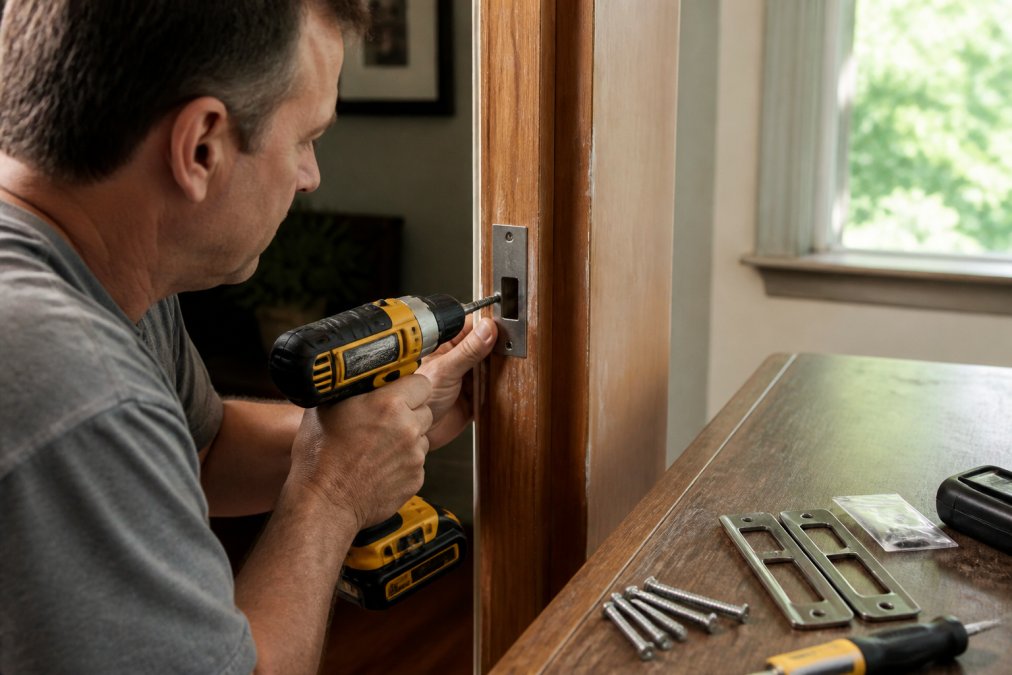
The entire process typically takes 30 minutes for a single door. Door Armor's Single Door Security Kit is designed for this exact workflow, with all components pre-matched and detailed instructions included.
Best Door Security for Renters: Non-Destructive Options
Renters face a unique challenge: you want to reinforce your door without making permanent modifications that could cost your security deposit. Door braces or wedges sit on the floor and angle against the door, preventing it from opening. These are portable and removable when you move, but only effective when you're home and actively using them.
Adhesive-backed security films can reinforce glass panels without drilling. These films make glass harder to break and slower to penetrate, buying time if someone tries to break in through a window.
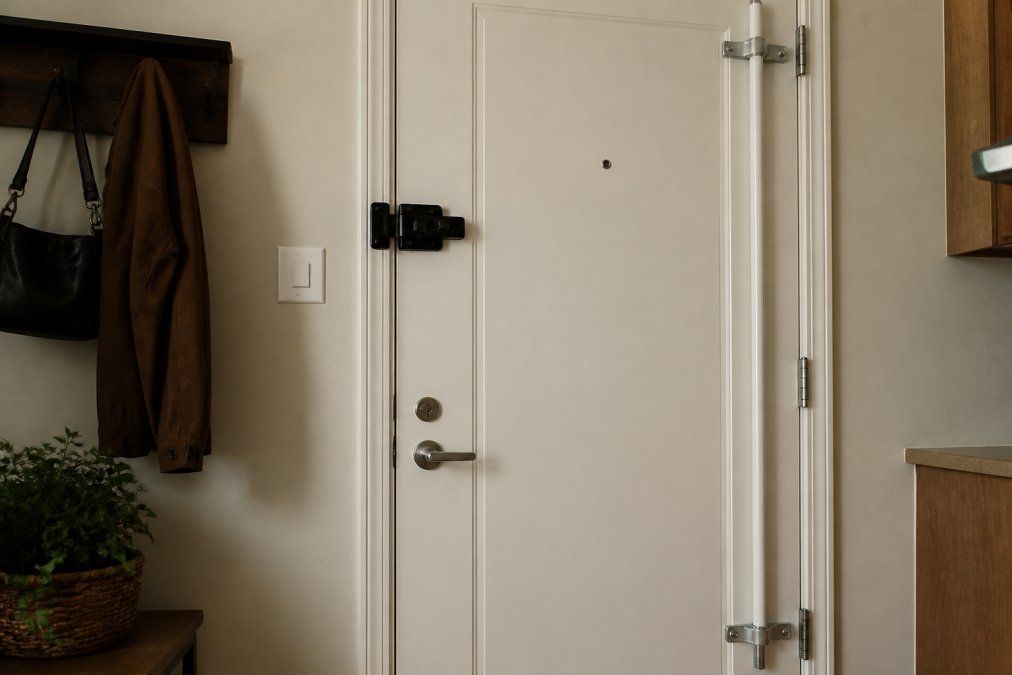
For renters willing to make minor modifications that can be reversed, temporary strike plate upgrades are possible. You can install a reinforced strike plate with long screws, then remove it when you move and fill the holes with wood filler. Ask your landlord about installing proper reinforcement, many appreciate the upgrade because it increases property value and reduces insurance claims.
Common Mistakes to Avoid During Installation
The most common mistake is using short screws. Many people assume the strike plate itself is the security component and don't realize that the screws are what actually hold it. Short screws (less than 1.5 inches) will pull free under force. Always use screws at least 2.5 inches long that penetrate into solid structural framing.
Another mistake is installing hardware on hollow-core doors without reinforcing the door itself. If you have a hollow-core exterior door, replace it with a solid core door first, or reinforce it with a steel backing plate behind the lock.
Many people also fail to reinforce all exterior doors. Installing reinforcement on your front door while leaving your back door standard is a false sense of security. Burglars target secondary entrances specifically because homeowners focus on the front.
Incorrect hole placement is another issue. If holes don't align with structural framing, screws won't hold properly. Before drilling, verify where the structural members are using a stud finder.
Over-tightening screws can strip the wood, especially in softer wood frames or older homes. Tighten until snug, then stop.
Finally, some people install reinforcement but fail to use a proper deadbolt. Reinforcement only works if you actually lock the door. A standard keyed entry lock isn't sufficient, you need a deadbolt that requires a key to retract.
Maintenance and Long-Term Protection
Door reinforcement hardware requires minimal maintenance. Check screws periodically, about every six months, to ensure they haven't loosened. Seasonal expansion and contraction of wood frames can cause screws to back out slightly.
Inspect the door frame for signs of damage, rot, or previous attempted break-ins. Wood rot can make screws less effective because they won't grip properly in compromised wood.
Keep deadbolts and locks clean and lubricated. A small amount of graphite powder (not oil, which attracts dirt) on the lock mechanism keeps it operating smoothly.
Galvanized steel (used in quality kits like Door Armor's) resists rust better than standard steel, but even galvanized hardware can corrode if exposed to salt spray or harsh weather. In coastal areas or regions with heavy snow and salt, inspect hardware more frequently.
The effectiveness of easy door reinforcement for beginners doesn't diminish over time if you maintain it properly. The hardware doesn't require electricity, internet connectivity, or regular updates.
Conclusion
Securing your home's entry points is one of the most effective security upgrades you can make. Easy door reinforcement for beginners is affordable, quick to install, and requires no special skills.
Door Armor's reinforcement kits are designed specifically for homeowners who want to upgrade without complications. Our patented galvanized steel systems are installed in under 30 minutes and backed by a $500 Lifetime Guarantee against kick-ins. With over 500,000 doors secured and a 20-year track record, Door Armor delivers the protection that matters. Shop now and get your doors secured today.
Frequently Asked Questions
What is the most effective way to prevent door kick-ins?
The most effective approach combines multiple reinforcement points: a strike plate with 3-inch screws anchored into the door frame studs, a deadbolt lock, and hinge shields on exterior doors. Together, these create structural integrity that resists forced entry. Door Armor's security kits address all three weak points simultaneously, which is why they're police-tested and come with a $500 lifetime guarantee against kick-ins. While no system is 100% burglar-proof, a complete system makes your door significantly harder to breach.
Can I install door reinforcement hardware if I am not handy?
Yes. Most DIY door reinforcement kits are designed for beginners and require only a power drill and basic tools. Door Armor's Single Door Security Kit installs in under 30 minutes without special skills. Pre-drilled holes and detailed instructions guide you through each step. If you're nervous, start with the strike plate and long screws, the easiest and most impactful upgrade. Many homeowners who've never used a drill before complete installation successfully. If something goes wrong, Door Armor offers customer support and a guarantee, so you're protected.
Are door reinforcement kits worth the investment for renters?
For renters, non-permanent reinforcement kits are worth the investment because they move with you and don't violate lease terms. A rental-friendly kit like Door Armor's can be removed without damage, protecting multiple properties over time. The cost ($79-$149) is far less than a security deposit forfeiture, property damage repairs, or stolen items after a break-in. Renters in high-crime areas or those managing vacant vacation properties see the most value. If you plan to stay in your rental for at least a year, the protection and peace of mind justify the expense.
How do I know if door reinforcement actually works against real break-ins?
Door Armor's system is police-tested and recommended, with over 500,000 doors secured over 20 years. The galvanized steel reinforcement targets the exact weak points where forced entry occurs: the strike plate, door frame, and hinges. These aren't theoretical vulnerabilities, they're where break-ins happen. The $500 lifetime guarantee against kick-ins reflects the company's confidence in the product. Customer testimonials from homeowners and property owners document real-world protection. While no system is 100% burglar-proof, reinforcement buys critical time to call for help or prepare a response, which is the primary goal of home hardening.
This article was written using GrandRanker
Frequently Asked Questions
What is the most effective way to prevent door kick-ins?
The most effective approach combines multiple reinforcement points: a strike plate with 3-inch screws anchored into the door frame studs, a deadbolt lock, and hinge shields on exterior doors. Together, these create structural integrity that resists forced entry. Door Armor's security kits address all three weak points simultaneously, which is why they're police-tested and come with a $500 lifetime guarantee against kick-ins. While no system is 100% burglar-proof, a complete system makes your door significantly harder to breach.
Can I install door reinforcement hardware if I am not handy?
Yes. Most DIY door reinforcement kits are designed for beginners and require only a power drill and basic tools. Door Armor's Single Door Security Kit installs in under 30 minutes without special skills. Pre-drilled holes and detailed instructions guide you through each step. If you're nervous, start with the strike plate and long screws—the easiest and most impactful upgrade. Many homeowners who've never used a drill before complete installation successfully. If something goes wrong, Door Armor offers customer support and a guarantee, so you're protected.
Are door reinforcement kits worth the investment for renters?
For renters, non-permanent reinforcement kits are worth the investment because they move with you and don't violate lease terms. A rental-friendly kit like Door Armor's can be removed without damage, protecting multiple properties over time. The cost ($79–$149) is far less than a security deposit forfeiture, property damage repairs, or stolen items after a break-in. Renters in high-crime areas or those managing vacant vacation properties see the most value. If you plan to stay in your rental for at least a year, the protection and peace of mind justify the expense.
How do I know if door reinforcement actually works against real break-ins?
Door Armor's system is police-tested and recommended, with over 500,000 doors secured over 20 years. The galvanized steel reinforcement targets the exact weak points where forced entry occurs: the strike plate, door frame, and hinges. These aren't theoretical vulnerabilities—they're where break-ins happen. The $500 lifetime guarantee against kick-ins reflects the company's confidence in the product. Customer testimonials from homeowners and property owners document real-world protection. While no system is 100% burglar-proof, reinforcement buys critical time to call for help or prepare a response, which is the primary goal of home hardening.