 ultimate-guide
Door Security for Old Houses: 7 Proven Methods
Table of Contents
- Why Old Houses Are Vulnerable to Forced Entry
- How to Prevent Door Kick-Ins with Steel Reinforcement
- Reinforcing Door Jambs and Strike Plates
- Securing Sliding Glass Doors in 2026
- Integrating Smart Home Security Technology
- Maintaining Historical Aesthetic While Adding Security
- Protecting Glass Panels and Sidelights
- Conclusion
- Frequently Asked Questions
Last Updated: September 1, 2026
Why Old Houses Are Vulnerable to Forced Entry
Old houses have charm and character, but their doors were built when security threats looked different. Builders prioritized aesthetics over resistance to forced entry. The fundamental problem is structural: most older doors sit in frames held by single screws in the strike plate. A determined kick exploits this weakness instantly, the wood splinters and the door swings inward. Modern building codes address this with reinforced frames and longer screws anchored into framing studs, but older homes remain vulnerable. Burglars know this and target old houses because entry points fail predictably. The good news: you don't need to replace your doors, only reinforce them.
How to Prevent Door Kick-Ins with Steel Reinforcement
Door kick-ins succeed because the strike plate tears free from the frame. Steel reinforcement solves this by distributing force across a wider area and anchoring deeper into structural wood. Galvanized steel plates shield the strike area and reinforce hinges simultaneously, creating a rigid connection between the lock mechanism and door frame studs. When force is applied, energy spreads across the reinforced zone instead of concentrating on strike plate screws.
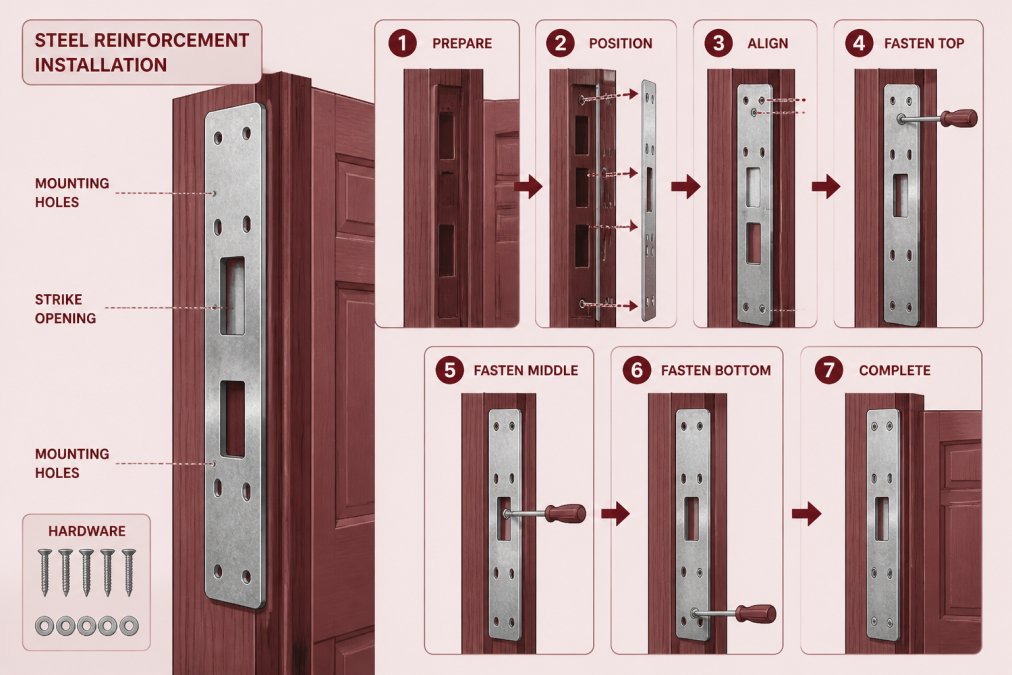
Installation takes under 30 minutes with just a drill and screwdriver. The Door Armor Single Door Security Set handles standard exterior doors up to 1-3/4 inches thick and includes hinge shields that prevent prying attacks. The system includes a $500 Lifetime Guarantee against kick-ins.
A typical kick generates 300-400 pounds of force concentrated on a small area. Strike plates held by four short screws can't withstand this. Steel plates anchored with longer screws into frame studs distribute that force across multiple connection points, making the wood itself part of the resistance system. A comprehensive system reinforces the strike area, hinges, and frame in a coordinated way, preventing attackers from exploiting alternative weak points.
Reinforcing Door Jambs and Strike Plates
The door jamb is the vertical piece of wood that holds the strike plate and is the critical weak point in most older doors. Reinforcement means upgrading the strike plate itself and strengthening the jamb behind it.
Installing Heavy-Duty Strike Plates
A heavy-duty strike plate is thicker than standard hardware and uses longer screws. A wrap-around or reinforced strike plate covers more jamb surface, distributing impact force across a larger area and preventing concentrated failure. Look for models that extend at least 6 inches along the jamb with screws at least 2.5 inches long, long enough to penetrate through the jamb into structural framing. Fill old screw holes with wood filler before installing the new plate to ensure proper alignment and connection strength.
Upgrading Hinges for Forced Entry Prevention
Hinges are a second attack vector. If someone removes the hinge pins from outside, the door swings inward regardless of the lock. Older doors often have exposed hinges accessible from the exterior. Hinge shields are metal plates that cover the hinge area and prevent access to pins. They're installed on the outside of the door and frame, creating a barrier between an attacker and the hinge mechanism.
The Door Armor system includes hinge shields sized for standard residential hinges. For homes with decorative hinges that are part of the aesthetic, non-removable pin hinges are available that maintain appearance while eliminating vulnerability.
Securing Sliding Glass Doors in 2026
Sliding glass doors present a different security challenge. They can be lifted out of their tracks or forced open by breaking the glass. A door jammer placed in the track prevents sliding, even if the lock is broken. Security film applied to the inside of the glass makes it harder to break through by holding glass together even after impact, preventing the quick entry that makes sliding doors attractive targets.
The Door Armor Side Light Door Security Kit addresses doors with side lights, which have no center jamb for reinforcement. The system uses jamb shields and hinge shields that create structural rigidity missing in standard installations. For sliding doors, the combination of a door jammer, security film, and a quality deadbolt creates multi-layer defense.
Integrating Smart Home Security Technology
Smart locks and video doorbells don't prevent forced entry, but they provide awareness and control. A smart doorbell shows who's at your door before they touch it. A smart lock lets you grant access remotely and logs every entry.
For old houses, smart technology works best alongside physical reinforcement. The reinforced door prevents the kick-in while the smart lock and camera give visibility into who is approaching. Smart locks for older doors must fit within the existing deadbolt hole. Most retrofit models do, but verify compatibility before purchasing. Installation is straightforward: remove the old lock cylinder and install the smart lock in its place.
The key principle is this: technology enhances physical security but doesn't replace it. A smart lock on a weak door is still a weak door. A reinforced door with a basic mechanical lock is more secure than a weak door with all the smart features.
Maintaining Historical Aesthetic While Adding Security
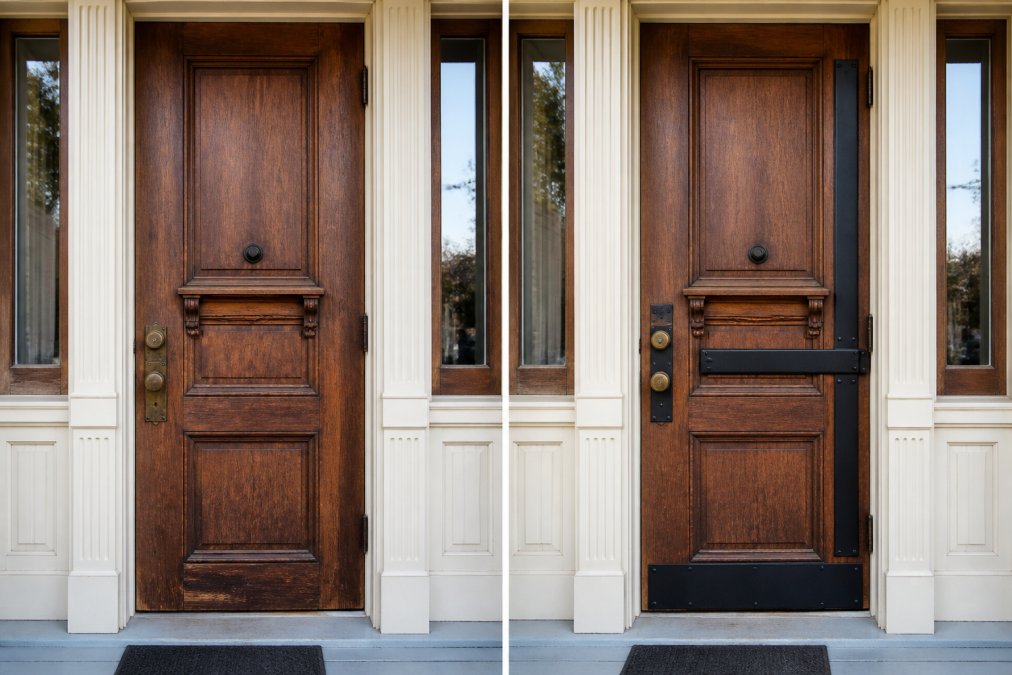
Security upgrades can look industrial and obvious. The solution is choosing finishes and styles that match existing hardware and trim.
Non-Destructive Installation Options
Non-destructive installation means you can remove security upgrades without damaging the door or frame. This matters if you're renting or planning to move. Adhesive-backed security films can be applied to glass without tools. Door jammers sit in the track without fastening. Some reinforcement systems use mounting plates that attach through existing hardware rather than drilling new holes. These approaches preserve the original door while adding security, though they're sometimes less strong than permanent installation.
Matching Antique Hardware and Period Finishes
Old houses have character in their hardware. When upgrading, specify finishes that match existing hardware. Satin nickel matches modern nickel-plated hardware. Oil-rubbed bronze matches antique bronze. Polished brass matches older brass fixtures. The Door Armor Single Door Security Set is available in satin nickel, which works with most older homes. Good security doesn't have to look like security, it can be integrated so completely that visitors don't notice it's there.
Protecting Glass Panels and Sidelights
Glass is a vulnerability. It's transparent and breakable, making it accessible without touching the lock. Security film applied to the inside of the glass makes it harder to break through by holding fragments together even after impact, requiring sustained effort to create an opening. Professional-grade security film is 4-8 mils thick and nearly invisible when applied correctly.
For doors with sidelights, the Door Armor Side Light Door Security Kit uses jamb shields and hinge shields to create structural rigidity in this weak area. The combination of security film, reinforced frames, and a solid lock creates multi-layer protection for glass.
Conclusion
Door security for old houses is achievable without sacrificing the character that makes these homes special. Physical reinforcement using galvanized steel components stops forced entry at weak points: the strike plate, hinges, and frame. Non-destructive installation options preserve the door if you're renting or planning to move. Finishes that match existing hardware blend security upgrades into the home's aesthetic.
The Door Armor Single Door Security Set delivers this protection in a single integrated system, installed in under 30 minutes. The $500 Lifetime Guarantee against kick-ins backs the protection with confidence. Whether you're securing a primary residence, a vacation property, or a rental unit, reinforced doors provide 24/7 protection that doesn't require power, internet, or maintenance. Get started with Door Armor and give your family the security they deserve.
| Security Method | Best For | Installation Time | Permanence |
|---|---|---|---|
| Steel reinforcement plates | Standard swinging doors | 20-30 minutes | Permanent |
| Heavy-duty strike plates | Strike plate replacement | 10-15 minutes | Permanent |
| Hinge shields | Preventing hinge pin removal | 15-20 minutes | Permanent |
| Security film | Glass panels and sidelights | 30-45 minutes | Semi-permanent |
| Door jammers | Sliding glass doors | 2 minutes | Non-destructive |
| Smart locks | Remote access and logging | 15-20 minutes | Removable |
Frequently Asked Questions
Q: How do I know if door security for old houses actually works against real break-ins?
A: Door Armor's galvanized steel reinforcement system has been police tested and recommended, with over 500,000 doors secured. The patented design prevents forced entry by reinforcing the weakest points, the door frame and hinges, where most kick-ins occur. The $500 Lifetime Guarantee against kick-ins backs the protection. Unlike deterrents alone, this system creates physical barriers that delay forced entry long enough to call for help.
Q: Can I install door security reinforcement without damaging my historic trim and original hardware?
A: Yes. Non-destructive installation options like Door Armor use galvanized steel shields that mount to existing hinges and door frames without permanent alteration. The system is designed to match antique hardware finishes and can be removed if you move or need to restore the door later. For sidelights and glass panels, security film provides protection without replacing original leaded glass or period details.
Q: What's the best way to secure sliding glass doors?
A: Sliding glass doors are vulnerable because they lack a traditional jamb. Use a combination of approaches: install a door jammer or security bar in the track to prevent sliding, apply security film to glass panels to resist shattering, and add a deadbolt or friction lock to the frame. For maximum protection, pair these with a wide-angle peephole and smart doorbell to monitor activity before opening.
Q: Do I need professional installation, or can I install door security myself?
A: Most door security systems, including Door Armor kits, are designed for DIY installation in under 30 minutes. No special tools are required. If you're uncertain about any step, Door Armor provides installation support. Rental properties benefit from removable, non-permanent options that don't require landlord approval or professional installation.
This article was written using GrandRanker
Frequently Asked Questions
Q: How do I know if door security for old houses actually works against real break-ins?
A: Door Armor's galvanized steel reinforcement system has been police tested and recommended, with over 500,000 doors secured. The patented design prevents forced entry by reinforcing the weakest points—the door frame and hinges—where most kick-ins occur. The $500 Lifetime Guarantee against kick-ins backs the protection. Unlike deterrents alone, this system creates physical barriers that delay forced entry long enough to call for help.
Q: Can I install door security reinforcement without damaging my historic trim and original hardware?
A: Yes. Non-destructive installation options like Door Armor use galvanized steel shields that mount to existing hinges and door frames without permanent alteration. The system is designed to match antique hardware finishes and can be removed if you move or need to restore the door later. For sidelights and glass panels, security film provides protection without replacing original leaded glass or period details.
Q: What's the best way to secure sliding glass doors?
A: Sliding glass doors are vulnerable because they lack a traditional jamb. Use a combination of approaches: install a door jammer or security bar in the track to prevent sliding, apply security film to glass panels to resist shattering, and add a deadbolt or friction lock to the frame. For maximum protection, pair these with a wide-angle peephole and smart doorbell to monitor activity before opening.
Q: Do I need professional installation, or can I install door security myself?
A: Most door security systems, including Door Armor kits, are designed for DIY installation in under 30 minutes. No special tools are required. If you're uncertain about any step, Door Armor provides installation support. Rental properties benefit from removable, non-permanent options that don't require landlord approval or professional installation.