 ultimate-guide
Door Reinforcement and Home Insurance: What Actually Matters
Table of Contents
- How Door Reinforcement Affects Your Homeowners Insurance
- Does a Deadbolt Lower Home Insurance Premiums?
- The Insurance Discount Myth vs. Reality
- Homeowners Insurance Security Discounts: What Qualifies
- Types of Door Reinforcement Hardware and Insurance Recognition
- How to Document Your Security Upgrades for Your Insurance Provider
- Forced Entry Prevention as Hazard Mitigation
- Frequently Asked Questions
Last Updated: September 21, 2026
How Door Reinforcement Affects Your Homeowners Insurance
Door reinforcement home insurance discounts don't automatically lower your homeowners insurance premium. Many homeowners assume that installing a deadbolt or reinforcing their door frame will trigger an immediate discount, but insurance companies evaluate risk holistically, examining your entire property's security posture, claims history, and specific upgrades.
The impact depends on whether your insurer recognizes the upgrade, how significant the security improvement is, and whether you've documented it properly. Some insurers offer modest discounts (typically 5-15%) for verified security enhancements; others may view your property more favorably during underwriting or claims assessment without offering a discount.
What matters most is that door reinforcement genuinely reduces your risk of forced entry, preventing property damage claims, theft claims, and potential liability issues.
Does a Deadbolt Lower Home Insurance Premiums?
A deadbolt alone typically does not lower your home insurance premium. Most standard deadbolts are considered basic security, already factored into baseline risk assessment by insurers.
A high-quality deadbolt paired with other reinforcement measures, such as a reinforced strike plate, door frame reinforcement, or a complete security system, may qualify for a modest discount with some insurers. A single upgrade rarely moves the needle on your premium.
What actually matters to insurers is the difficulty of forced entry. A standard deadbolt can be defeated in seconds with a kick or pry attempt, while a reinforced door assembly with hinge shields, strike plate reinforcement, and frame bracing creates genuine resistance to forced entry.
The Insurance Discount Myth vs. Reality
Most guides overstate the financial incentive of door reinforcement and insurance discounts. The truth is messier than the typical "install upgrades and get savings" narrative.
Insurance discounts for security upgrades typically range from 5-10% if offered at all. For a homeowner paying $1,200 annually, a 5% discount equals $60 per year, a 3-6 year payback period on a $200-400 installation cost.
The real benefit of door reinforcement is hazard mitigation. Reducing your risk of break-in prevents property damage, theft, and home invasion claims, protecting your claims history and keeping premiums stable over time.
Some insurers offer discounts; others view hazard mitigation favorably during underwriting without discounting. Install door reinforcement because it works, not for a windfall discount.
Homeowners Insurance Security Discounts: What Qualifies
Not all security upgrades qualify for door reinforcement home insurance discounts; eligibility varies significantly between insurers and by state. Check with your insurance provider about what they'll recognize before investing in door reinforcement.
Standard Discount-Eligible Upgrades (offered by most major insurers):
- Monitored alarm systems (hardwired or professional monitoring), typically 10-15% discount
- Security cameras with recording capability, typically 5-10% discount
- Smart locks with remote access and activity logging, typically 5% discount
- Reinforced entry doors or security doors, typically 5-10% discount
- Deadbolts meeting ANSI Grade 1 or 2 standards, rarely standalone, usually 2-5% if paired with other measures
Commonly Recognized but Discount-Dependent Upgrades:
- Window locks and reinforcement, 2-5% if part of comprehensive security
- Motion-sensor lighting, 2-5% if exterior coverage
- Reinforced door frames and strike plates, 2-5% if professionally installed and verified
- Multi-point locking systems, 5-10% if Grade 1 certified
What Typically Does NOT Qualify for a Discount:
- Basic deadbolts without additional reinforcement
- Standalone door reinforcement without a monitored system or professional verification
- Passive security measures (landscaping, visibility improvements)
- DIY installations without certification or professional verification
- Older or non-certified hardware
State-Specific Considerations: Some states mandate specific door reinforcement standards for hurricane-prone areas (Florida, Louisiana, Texas, South Carolina) or wildfire-prone regions (California). Insurers may require certain door upgrades as a condition of coverage rather than offering them as optional discounts. Check your state's insurance commissioner's office or your insurer's specific requirements for your region.
The Documentation Requirement: Your insurance company wants documented, verifiable security improvements. A professional installation with a warranty carries significantly more weight than a DIY project because insurers need to verify that the product meets specifications, installation was performed correctly, and there's warranty recourse if the product fails.
A professional installer provides a signed invoice with product specifications, proof of installation date and method, warranty documentation, and industry standard certification. DIY installations require product documentation, installation photos, and proof of purchase, though many insurers will discount the upgrade's value or require a home inspection to verify quality.
Door Armor Single Door Security Set →
Discount Verification Process: Contact your insurance agent or company and request a security upgrade review. Ask whether the upgrade qualifies for a discount, if you should update your policy, and whether they'll conduct a home inspection to verify the upgrade. Some insurers will inspect at no cost; others accept photos and documentation. If you've installed quality hardware correctly and professionally, an inspection will confirm the value of your investment.
Types of Door Reinforcement Hardware and Insurance Recognition
Door reinforcement hardware comes in several categories, evaluated by insurers based on measurable security standards and proven resistance to forced entry.
Strike Plate Reinforcement replaces standard strike plates with heavy-duty versions extending 3+ inches into the frame (versus standard 1.25 inches), distributing force across more framing material and preventing frame splitting. ANSI Grade 1 certified strike plates withstand repeated impact and prying attempts. Most insurers recognize them as legitimate security measures, though they rarely qualify for standalone discounts without additional reinforcement.
Hinge Shields are metal plates that cover the hinge mechanism and prevent access to the hinge pin, protecting against a critical vulnerability where standard hinges can be compromised in seconds. They're particularly important on outward-opening doors. Insurers view hinge protection favorably when paired with other reinforcements.
Door Frame Reinforcement strengthens the frame assembly by reinforcing the strike side jamb and header. The frame is the weakest link in most residential doors, a forceful kick concentrates pressure on a small area of wood, causing it to split. Comprehensive frame reinforcement distributes force across a wider area and adds structural rigidity. Some systems use steel-reinforced brackets or galvanized steel channels bolted through the frame into wall studs, resisting both kick-in and prying attacks. Insurers recognize comprehensive frame reinforcement as a significant security upgrade, particularly when tested for impact resistance.
Security Doors are pre-manufactured doors with reinforced construction, typically made from steel, fiberglass, or composite materials with solid cores rather than hollow cores. These doors are heavier (often 50+ pounds compared to 30-40 pounds for standard doors) and have reinforced frames built in. They're professionally installed and come with manufacturer specifications and warranties. Security doors typically qualify for insurance discounts because they're verifiable, professionally installed, and meet established security standards. However, they're significantly more expensive than hardware-only reinforcement, ranging from $500 to $2,000+ per door installed.
Multi-Point Locking Systems lock the door at multiple points (top, middle, bottom) rather than just at the deadbolt. These systems distribute locking force across the entire door height, preventing the door from flexing or separating from the frame under pressure. They're common in commercial applications and high-security residential installations. Some insurers recognize them for discounts, particularly if they're part of a broader security system or if they meet ANSI Grade 1 standards.
How to Document Your Security Upgrades for Your Insurance Provider
Documentation is where most homeowners fall short. You can install the best door reinforcement system available, but if your insurance company doesn't know about it, it won't affect your premium or your claims assessment.
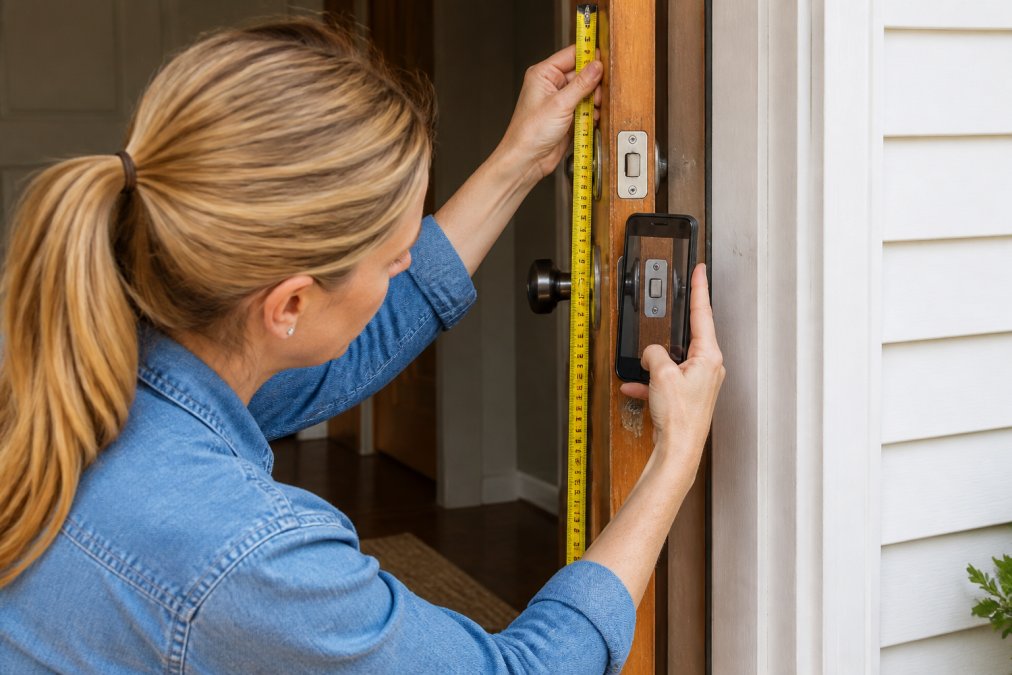
Start by photographing your installation. Take clear photos of:
- The complete door assembly (full view)
- Close-ups of the deadbolt and strike plate
- Hinge shields and frame reinforcement
- Any labels or serial numbers on the hardware
- Before-and-after comparisons if possible
Keep all receipts and product documentation. This includes:
- Invoices showing what was purchased and when
- Product specification sheets
- Installation instructions or warranty documentation
- Proof of professional installation if applicable
Create a written summary document that lists:
- What security upgrades were installed
- Where they were installed (front door, back door, etc.)
- Installation date
- Product brand and model numbers
- Total cost of the project
- Any certifications or standards the products meet (ANSI Grade, etc.)
Contact your insurance agent or company and request a security upgrade review. Provide your photos and documentation. Ask specifically:
- Will this qualify for a discount?
- Should I update my policy to reflect these improvements?
- Does this affect my coverage or deductible?
Forced Entry Prevention as Hazard Mitigation
Insurance companies use the term "hazard mitigation" to describe actions that reduce your property's risk exposure. Forced entry prevention is textbook hazard mitigation. When you make it significantly harder for someone to kick in your door or pry it open, you're reducing the likelihood of a break-in claim.
Frequently Asked Questions
Does installing door reinforcement hardware actually lower my homeowners insurance premium?
Most insurers do not automatically reduce premiums for door reinforcement alone. However, some carriers offer modest discounts (typically 5-15%) if the reinforcement meets their specific security standards and you document the upgrade. The real value lies in hazard mitigation: reinforced doors reduce break-in risk, which can lower your claims history and prevent costly property damage. Always contact your insurance provider before installation to ask if your specific upgrades qualify for a discount.
What qualifies as a security device for homeowners insurance discounts?
Insurance companies typically recognize deadbolts, strike plates, security doors, and monitored alarm systems. Physical door reinforcement hardware that prevents forced entry may qualify, but recognition varies by insurer. Some carriers specifically require industry-standard products. Your best approach: ask your insurance agent for a written list of approved security devices before purchasing. Document the product specifications and installation with photos and receipts.
How do I prove my door security upgrades to my insurance company?
Document everything with photos showing the installed hardware, product packaging with specifications, and receipts. Take before-and-after photos of each door. Write a brief summary noting the installation date, product name, and manufacturer. Send this documentation to your insurance agent or submit it through your online policy portal. Include the product's police recommendation if available. Keep copies for your records in case you need to file a claim.
Is door reinforcement considered hazard mitigation that insurers care about?
Yes. Hazard mitigation reduces the likelihood of property damage or theft. Reinforced doors that prevent forced entry directly reduce your risk profile. Insurers view this favorably because it lowers the probability of a claim. While you may not see an immediate premium reduction, demonstrating hazard mitigation efforts can support your case if you're shopping for better rates or if your insurer reviews your policy. It also strengthens your position if you file a claim, showing you took reasonable steps to protect your property.