 listicle
Best Residential Door Reinforcement Brands 2026
Table of Contents
- What Makes a Residential Door Reinforcement Brand Worth Buying
- How to Reinforce a Front Door Against Kick-Ins: What the Hardware Does
- Best Door Security System 2026: Door Armor Single Door Kit
- Door Reinforcement Kit Installation Guide for DIY Homeowners
- Specialized Kits for Double Doors and Sliding Glass Doors
- Why Door Reinforcement Brands Matter: Protection Beyond the Deadbolt
- Rental-Friendly and Aesthetic Considerations
- Conclusion
Last Updated: August 23, 2026
What Makes a Residential Door Reinforcement Brand Worth Buying
Your front door is the most common entry point for forced entry. Most homeowners believe a standard deadbolt is enough. It isn't. A determined intruder can kick through a standard door frame in seconds because the lock rarely fails, the frame does. This is where residential door reinforcement brands matter.
The difference between a door that resists forced entry and one that doesn't comes down to hardware: how well the strike plate anchors into the door jamb, whether hinges are protected from prying, and if the door frame has structural support where it matters most. Door Armor has spent over 20 years refining this approach, building galvanized steel systems that stop kicks and prying at the weak points every standard door shares.
What separates the best brands from generic hardware kits is engineering. A cheap strike plate extends maybe half an inch into the jamb. A reinforced one goes 3 inches deeper, into the structural framing behind the drywall. That difference, combined with reinforced hinges and jamb shields, is the difference between a door that holds and one that splinters.
This guide covers the best residential door reinforcement brands available in 2026, how their hardware works, and which kits suit different door types. Whether you're securing a single entry door, protecting double doors, or reinforcing sliding glass doors, the right system provides what matters most: time to call for help, reach safety, and allow authorities to respond.
How to Reinforce a Front Door Against Kick-Ins: What the Hardware Does
Kick-in attacks target the weakest structural point: where the strike plate meets the door jamb. A standard strike plate is held by two or three short screws that grip only surface wood. When force is applied, the screws rip through and the door opens.
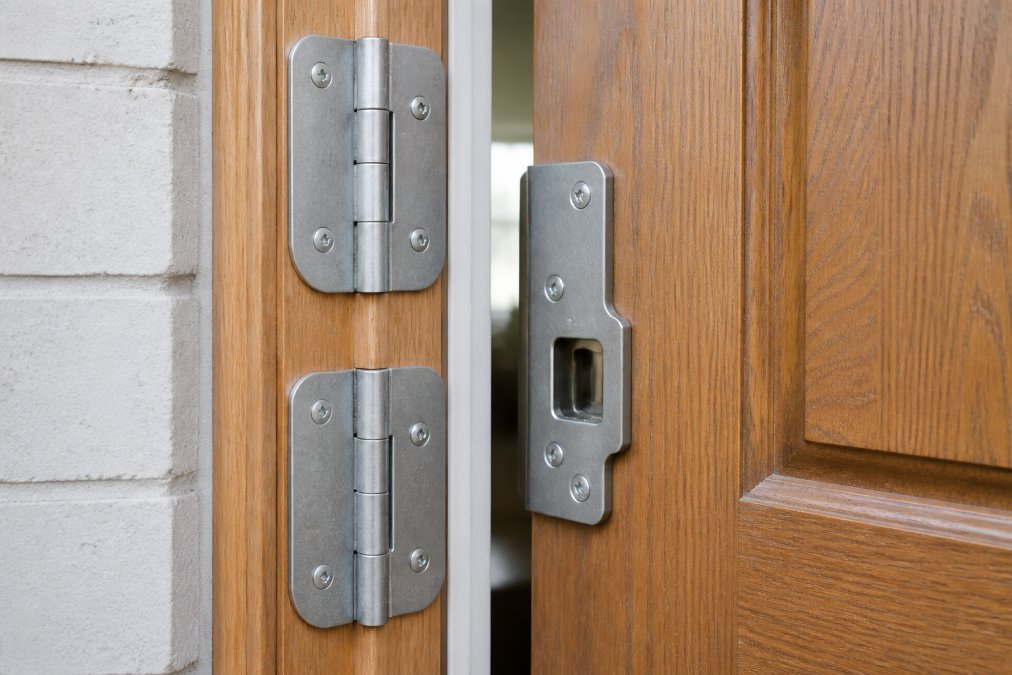
Anti-kick reinforcement works by moving load-bearing points deeper into the structure. Reinforced strike plates use 3-inch screws that penetrate through the jamb into solid framing, creating a connection that can't be separated by kicking. Hinge shields cover the hinge area and distribute force across a wider surface, making prying ineffective while preventing hinge pin removal. Jamb shields reinforce areas lacking rigidity, especially on doors with side lights or double doors, creating structural connection between the frame and solid framing behind it. Door sweep reinforcement anchors the bottom corner of the door frame to prevent prying or lifting.
Together, these components create a hardened entry point. The door itself doesn't need to be steel; the reinforcement system makes weak points strong enough to resist forced entry.
Best Door Security System 2026: Door Armor Single Door Kit
Door Armor's Single Door Security Kit is the benchmark for residential door reinforcement. It includes a reinforced strike plate with 3-inch screws anchoring into structural framing, hinge shields protecting hinges from prying, and a door jamb shield adding rigidity where doors often fail. Installation takes under 30 minutes with basic tools.
The strike plate distributes force across a wider area of structural framing. Hinge shields are shaped to prevent the use points prying tools need. The jamb shield resists both kicking and prying simultaneously.
At $79.00, you're paying for components engineered specifically to stop forced entry mechanics. The $500 Lifetime Guarantee against kick-ins backs this engineering.
Best for single exterior doors up to 1-3/4 inches thick, this kit covers front doors, back doors, and side doors. For multiple entry points, purchase multiple kits. For double doors or sliding glass doors, Door Armor offers specialized systems.
Door Reinforcement Kit Installation Guide for DIY Homeowners
Installing a door reinforcement kit requires no special skills, but precision matters.
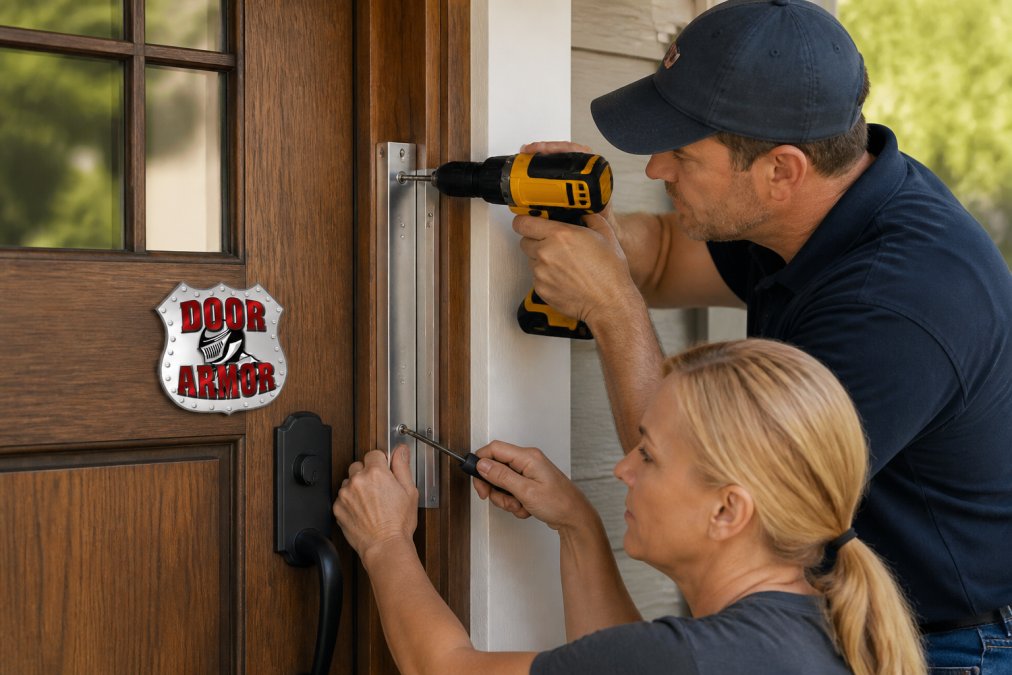
Step 1: Assess Your Door and Gather Tools
Measure your door thickness (most residential doors are 1-3/4 inches). Verify your door frame is wood. Gather a drill, screwdriver, level, and measuring tape. Most kits include all hardware needed.
Step 2: Remove the Existing Strike Plate
Unscrew the existing strike plate. Inspect screw holes for damage; fill stripped holes with wood filler if needed. This takes 5 minutes.
Step 3: Install the Reinforced Strike Plate
Position the new strike plate aligned with the existing bolt hole. Mark new screw holes extending deeper into the jamb. Drill pilot holes to prevent splitting. Insert 3-inch screws, which penetrate through the jamb into structural framing. Tighten firmly. This takes 10 minutes.
Step 4: Install Hinge Shields
Position shields to cover hinge barrels completely. Mark screw holes, drill pilots, and secure with provided screws. Ensure shields are flush against the frame. This takes 8 minutes.
Step 5: Install Jamb Shields (if applicable)
Position jamb shields vertically along the door jamb. Mark, drill, and secure with provided fasteners. This takes 5 minutes.
Step 6: Test the Installation
Close the door and engage the deadbolt. The door should close smoothly without binding. Open and close it several times to verify proper operation.
The entire process takes 30-45 minutes for a single door. The most common mistake is under-tightening fasteners.
Specialized Kits for Double Doors and Sliding Glass Doors
Not all entry points are single doors. Double doors and sliding glass doors present different vulnerabilities requiring different reinforcement approaches.
Double Door Security Kit with Night Lock Barricade
Double doors lack a center jamb, creating structural weakness. The two doors meet at a vertical seam with no solid support behind it, making this seam easier to force open than a single door with a center jamb.
Door Armor's Double Door Security Kit reinforces the top, bottom, and hinge areas of both doors and includes a Night Lock door barricade that prevents doors from being forced open by securing them simultaneously at top and bottom.
Price: $149.00.
Best for: French doors, patio door pairs, and any double-door entry point where the lack of a center jamb creates vulnerability.
Side Light Door Security Kit
Doors with side lights present a unique problem. The side light area has no traditional jamb to anchor reinforcement into. An intruder could break the glass and reach through to unlock the door, or force the side light frame itself.
Door Armor's Side Light Kit uses a Sidelight Jamb Shield that screws into the face of the jamb, creating structural rigidity. Sidelight Hinge Shields attach the door frame to structural framing at top and bottom, preventing frame separation.
Price: $129.00.
Best for: Doors with one or two side lights, entryways where aesthetic concerns matter, and properties where the side light area is a known vulnerability.
Armor Latch Sliding Door Deadbolt
Sliding glass doors are vulnerable because they can be lifted off their tracks. Standard locks prevent sliding but not lifting. The Armor Latch Sliding Door Deadbolt uses a heavy-duty locking mechanism that prevents the door from lifting.
Price: $39.99.
Best for: Sliding patio doors, sliding glass doors on decks, and any sliding door where lift-off is the primary concern.
Why Door Reinforcement Brands Matter: Protection Beyond the Deadbolt
The deadbolt is a lock preventing entry with a key. It does not prevent forced entry. A forced entry attack targets the frame, not the lock. The lock is irrelevant if the frame separates from the jamb.
Standard door frames are built for weatherproofing and aesthetics, not security. Builders use short screws in strike plates because they're cheaper and faster. Hinges are exposed because that's standard. Door jambs are sized for code compliance, not structural strength. These choices create security vulnerabilities that reinforcement fixes.
Physical security operates on target hardening: make an entry point harder to breach than the next one, and an intruder will choose the next one. Door reinforcement accomplishes this by addressing specific weak points that forced entry exploits. Brands that matter understand this mechanics and engineer hardware around how forced entry actually works.
Rental-Friendly and Aesthetic Considerations
Not every homeowner can make permanent changes to doors. Renters face restrictions on modifications. Some homeowners prioritize aesthetics and don't want their entry door to look fortified.
For renters, removable solutions exist with tradeoffs. The Armor Latch Sliding Door Deadbolt can be removed without visible damage. Strike plate reinforcement requires drilling into the door frame, a permanent modification that landlords typically prohibit. The best rental-friendly approach focuses on what you can control: locks, barricades, and portable security devices.
For homeowners concerned about aesthetics, reinforcement hardware is less visible than it appears. Hinge shields are on the exterior of hinges, typically facing away from the street. Strike plate reinforcement uses the same mounting points as standard plates, so visual change is minimal. Jamb shields are thin and match door frame color. Reinforcement is functional rather than decorative.
| Consideration | Single Door Kit | Double Door Kit | Side Light Kit | Sliding Door Deadbolt |
|---|---|---|---|---|
| Rental-Friendly | No (permanent) | No (permanent) | No (permanent) | Partial (removable) |
| Aesthetic Impact | Minimal | Moderate | Minimal | Minimal |
| Installation Time | 30 minutes | 45 minutes | 35 minutes | 10 minutes |
| Price | $79.00 | $149.00 | $129.00 | $39.99 |
| Best For | Standard doors | French/patio doors | Doors with glass panels | Sliding glass doors |
Residential door reinforcement is not a luxury. It's a practical response to a universal vulnerability in how homes are built. The deadbolt is a lock; locks are bypassed through the frame. Brands that matter engineer solutions to frame vulnerabilities, not generic "security" products.
Door Armor's approach, deeper strike plate anchors, hinge protection, jamb reinforcement, and specialized kits for non-standard doors, addresses the actual mechanics of forced entry. The $500 Lifetime Guarantee reflects confidence in this engineering. For homeowners serious about preventing forced entry, this is where protection starts.
FBI Uniform Crime Reporting statistics on residential burglary trends
National Institute of Justice research on home security effectiveness
American Society of Crime Prevention Professionals guidelines on residential security
Frequently Asked Questions
Q: Do door reinforcement kits actually prevent kick-ins?
A: Yes. Residential door reinforcement kits strengthen the weakest points where forced entry typically occurs: the strike plate, door jamb, and hinges. Galvanized steel reinforcement hardware transfers the force of a kick across a wider structural area, making it significantly harder to breach. Door Armor kits carry a $500 Lifetime Guarantee against kick-ins, backed by police testing and 20+ years of real-world performance.
Q: What should I look for when buying door security hardware?
A: Prioritize hardened steel construction, strike plate reinforcement, hinge protection, and jamb reinforcement. Check for tamper-resistant design, DIY installation capability, and compatibility with your door type (standard, double, or side-light). Verify the brand offers a structural guarantee and has police or third-party testing. Door Armor's kits address all these factors and install in under 30 minutes without special tools.
Q: How do I choose the right door reinforcement brand for my home?
A: Match the kit to your door type first: single doors, double doors, or sliding glass doors require different hardware. Evaluate installation difficulty and time commitment. Compare lifetime guarantees and warranty coverage. Consider aesthetic impact if visible hardware concerns you. Door Armor offers purpose-built kits for each door type, with discreet finishes that blend with existing hardware while providing full structural reinforcement.
Q: Can I install door reinforcement hardware if I'm renting?
A: Most door reinforcement kits require permanent screwing into the door frame and jamb, which renters cannot do without damaging the property. However, some solutions like door barricades and sliding door deadbolts are removable. If you rent, check your lease and contact your landlord before installation. Door Armor kits are designed for homeowners; renters should explore temporary security options or request landlord approval before reinforcing rental properties.
This article was written using GrandRanker
Frequently Asked Questions
Q: Do door reinforcement kits actually prevent kick-ins?
A: Yes. Residential door reinforcement kits strengthen the weakest points where forced entry typically occurs: the strike plate, door jamb, and hinges. Galvanized steel reinforcement hardware transfers the force of a kick across a wider structural area, making it significantly harder to breach. Door Armor kits carry a $500 Lifetime Guarantee against kick-ins, backed by police testing and 20+ years of real-world performance.
Q: What should I look for when buying door security hardware?
A: Prioritize hardened steel construction, strike plate reinforcement, hinge protection, and jamb reinforcement. Check for tamper-resistant design, DIY installation capability, and compatibility with your door type (standard, double, or side-light). Verify the brand offers a structural guarantee and has police or third-party testing. Door Armor's kits address all these factors and install in under 30 minutes without special tools.
Q: How do I choose the right door reinforcement brand for my home?
A: Match the kit to your door type first: single doors, double doors, or sliding glass doors require different hardware. Evaluate installation difficulty and time commitment. Compare lifetime guarantees and warranty coverage. Consider aesthetic impact if visible hardware concerns you. Door Armor offers purpose-built kits for each door type, with discreet finishes that blend with existing hardware while providing full structural reinforcement.
Q: Can I install door reinforcement hardware if I'm renting?
A: Most door reinforcement kits require permanent screwing into the door frame and jamb, which renters cannot do without damaging the property. However, some solutions like door barricades and sliding door deadbolts are removable. If you rent, check your lease and contact your landlord before installation. Door Armor kits are designed for homeowners; renters should explore temporary security options or request landlord approval before reinforcing rental properties.