 ultimate-guide
Benefits of Installing a Door Security Bar
Table of Contents
- Why Door Security Bars Matter: The 3-Second Reality of Forced Entry
- Top Benefits of Installing a Door Security Bar
- How to Prevent Door Kick-Ins: A Step-by-Step Reinforcement Plan
- Door Security Bar vs Door Armor: Which Fits Your Door?
- Best Door Security Devices for Renters
- Emergency Egress and Peace of Mind: What to Check Before You Buy
- Conclusion
- Frequently Asked Questions
Last Updated: September 26, 2026
Why Door Security Bars Matter: The 3-Second Reality of Forced Entry
Most residential break-ins don't involve lock picking or sophisticated tools. They involve a single, violent kick. A door security bar is a physical reinforcement device that braces your existing door against exactly that kind of impact, buying you the seconds that matter most.
The FBI Uniform Crime Reporting Program tracks burglary as a persistent property crime category, and the pattern across reported incidents is consistent: the door is the target. At Door Armor, we've spent over 20 years in business, and the answer is almost never the lock itself. It's the frame, the strike plate, and the jamb giving way under pressure.
Here's the part most guides skip.
Where Doors Fail Under Kick-In Pressure
The weak point is rarely the locking mechanism. It's the door frame integrity around it.
Top Benefits of Installing a Door Security Bar
The clearest benefit of installing a door security bar is kick-in resistance at the exact point where doors fail. It converts a soft, splinter-prone jamb into a braced, tamper-proof barrier. But the advantages go well beyond raw impact resistance, and the ones that matter most are the ones most guides never quantify.
Immediate Kick-In Resistance
A security bar wedges between the door handle and the floor, redirecting kick force downward instead of into the frame. Combined with a reinforced strike plate, this creates a physical barrier that holds under repeated impact. The goal isn't to make a door impenetrable. It's to make it slow enough that the attempt fails or the intruder moves on.
Forced-Entry Effectiveness: What the Mechanism Actually Does
The reason a bar works comes down to load path. When a boot hits a door near the handle, the force transfers into the strike plate, the small metal plate screwed into the jamb where the deadbolt rests. That plate is typically held by short screws that anchor into soft wood trim, not the structural framing behind it.
No Power, No Batteries, Always Active
Smart locks and cameras are valuable, but they depend on power, Wi-Fi, and functioning batteries. A mechanical door security bar has none of those dependencies. It's a passive, always-active defense that works during an outage, a dead router, or a cut phone line.
The Visual Deterrent Factor
Most guides focus on what a bar does during an attack. Just as important is what it does before one starts. Burglars case a target. A visible brace bar, a reinforced strike plate, or a jamb shield signals that this door will take time and noise to defeat, two things an intruder wants to avoid.
Compatibility Across Door Types
A brace-style bar is not universal. It works best on inward-swinging doors with a standard handle height and a flat floor surface beneath the door. It does not work on outward-swinging doors, French doors, or doors with a raised threshold that prevents the bar's foot from seating.
Durability and Maintenance
A steel bar with a non-slip rubber foot has no moving parts to fail and typically needs nothing more than a wipe-down and an occasional check that the rubber foot hasn't hardened or cracked. Permanent reinforcement hardware is galvanized to resist corrosion and is designed to outlast the door it protects.
Integration With Smart Home Security
A door security bar is not a replacement for a smart lock or an alarm system, it's the layer underneath them. Smart locks control who can enter and log when they do. Alarm systems detect and alert after entry. Neither stops a kick. A bar or reinforcement kit handles the physical breach that electronics can't, while the smart layer handles access control, monitoring, and notification.
How to Prevent Door Kick-Ins: A Step-by-Step Reinforcement Plan
Preventing door kick-ins comes down to two things: identifying the weak points, then reinforcing them with hardware that spreads impact force. Most homeowners can complete both steps in under an hour.
Step 1: Inspect Your Door Frame and Strike Plate
Open the door and look at the strike plate, the metal plate on the jamb. Check the screws holding it in place. Short screws, usually under an inch, are a red flag. They anchor into trim, not framing. Also check the door jamb for cracks, soft spots, or previous repair marks, all signs of prior forced entry damage.
Door Armor Double Door Security Kit →
- Strike plate screws are at least 3 inches long
- No visible cracks or splintering around the jamb
- Deadbolt extends fully into the strike plate
- Hinges are secured with long screws on the frame side
Step 2: Install a Door Security Bar or Reinforcement Kit
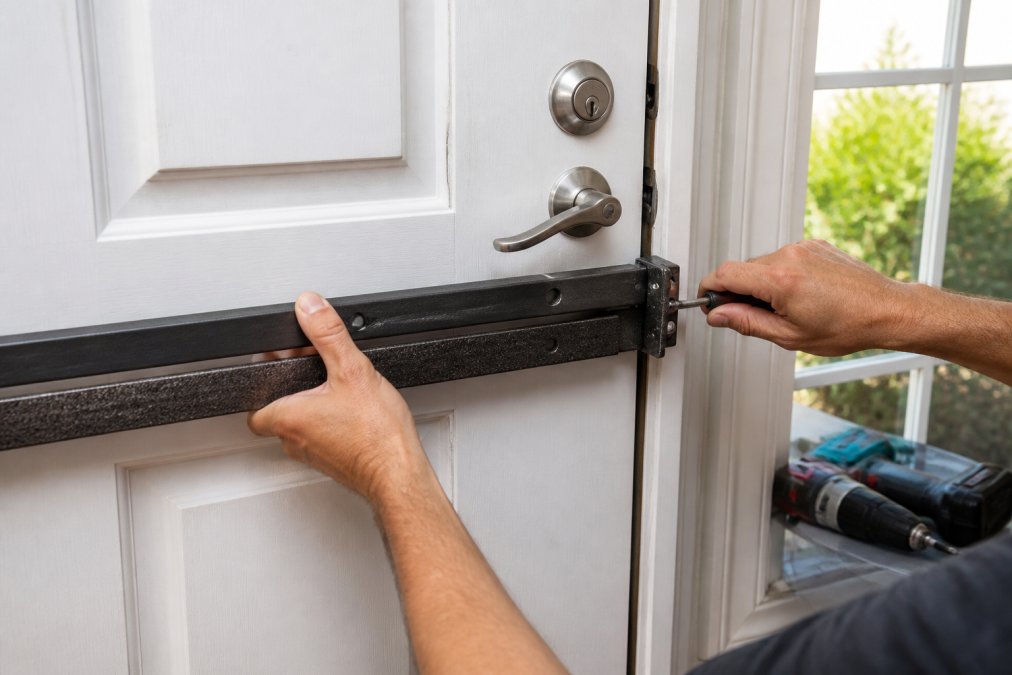
A portable bar slides under the handle and braces against the floor, no tools required. A permanent reinforcement kit, like the Door Armor Single Door Security Set, replaces the strike plate and hinge screws with galvanized steel components that anchor deep into the framing. Installation takes about 30 minutes with basic tools.

Door Security Bar vs Door Armor: Which Fits Your Door?
A door security bar is a portable, brace-style device that wedges under the handle. Door Armor is a permanent, installed reinforcement system that protects the strike plate, hinges, and jamb as a complete unit. They solve the same problem with different trade-offs.
| Feature | Door Security Bar | Door Armor System |
|---|---|---|
| Installation | No tools, slides in place | 30-minute DIY install |
| Protection scope | Handle-side brace only | Strike plate, hinges, jamb |
| Portability | Travels with you | Permanent, discreet |
| Best for | Renters, travel | Homeowners, permanent defense |
| Always active | Yes | Yes |
Best Door Security Devices for Renters
Renters face a constraint most security guides ignore: you can't drill into the floor, the frame, or the door, and anything you install has to come out clean at move-out. That rules out most permanent reinforcement kits, but it doesn't leave you unprotected. The rental-friendly options below install without permanent modification and travel with you.
Portable Brace Bars
A portable security bar is the default rental solution. It wedges under the door handle and braces against the floor at an angle, so kick force is redirected downward instead of into the jamb. Look for three features:
- Adjustable length so it fits different door widths and handle heights across apartments.
- A non-slip rubber foot that grips hard flooring and low-pile carpet without scratching.
- A steel core, not plastic, since the bar itself has to absorb the impact.
Non-Destructive Reinforcement Plates
A brace bar protects the handle side only. The hinge side of the frame remains exposed. For renters who want coverage there without permanent changes, removable reinforcement plates install using the existing screw holes in the strike plate and hinge jamb. You remove the factory screws, seat the plate, and re-drive longer screws through the plate into the same holes.
Door Wedges and Travel Locks
For hotel rooms, short-term rentals, and apartments where even screw-swapping isn't allowed, a heavy rubber door wedge or a portable travel lock that seats in the strike plate adds a layer of friction. These are not kick-in rated the way a steel brace bar is, but they raise the effort required and are genuinely portable.
What to Check Before You Buy
Renters should verify four things before ordering:
- Swing direction, brace bars only work on inward-swinging doors.
- Threshold height, a raised threshold can prevent the bar's foot from seating flat.
- Floor surface, the non-slip foot needs a hard, level surface to grip.
- Lease terms, confirm whether screw-swapping counts as a modification before you touch the strike plate.
A rental-friendly setup won't match a full permanent reinforcement system, but it closes the two biggest gaps, handle-side and hinge-side kick pressure, without costing you your deposit.
Emergency Egress and Peace of Mind: What to Check Before You Buy
Any door reinforcement must still allow you to exit fast in a fire or emergency. This is the safety standard most buyers overlook, and it's non-negotiable.
Conclusion
Reinforcing your entry points is one of the few home security upgrades that works without power, without an app, and without a subscription. The challenge is choosing hardware that protects the frame, not just the lock, while keeping your emergency exit clear.
Frequently Asked Questions
Are door security bars worth it for apartment renters?
Yes. Many door security bars and reinforcement kits are designed to be non-permanent, using existing screws or pressure-fit mechanisms that leave no lasting damage. This makes them ideal for renters who want to prevent door kick-ins without violating a lease. For example, Door Armor's Single Door Security Set installs in about 30 minutes.
How do door security bars prevent forced entry?
A door security bar reinforces the weakest points of a door, typically the lock area, hinges, and frame. By adding a physical barrier such as a heavy-duty steel bar or jamb shield, it distributes the force of a kick or shoulder hit across a larger area. This increases kick-in resistance and delays a burglar, giving you time to call for help. Many products, like Door Armor, also include tamper-proof hardware to prevent prying.
Can a door security bar be used on all door types?
Most door security bars work on standard single doors, but double doors, sliding doors, and doors with side lights require different solutions. For example, Door Armor offers a Double Door Security Kit and a Side Light Door Security Kit that address the unique weak points of those doors. Always check the product specifications to ensure compatibility with your door thickness and frame type.
What is the difference between a door security bar and a door jammer?
A door security bar typically refers to a horizontal bar that braces against the door handle or floor, while a door jammer is a portable device that wedges under the door handle and against the floor. Both add kick-in resistance. Door Armor's system is a comprehensive reinforcement kit that includes jamb shields and hinge shields, offering broader protection than a standalone bar.