 comparison
Asafehome Alternative for Front Doors: 3 Door Armor Kits
Table of Contents
- Why Homeowners Look for an Asafehome Alternative for Front Doors
- Door Armor Kits at a Glance: Features and Pricing
- How to Prevent Door Kick-Ins: What Actually Works
- Door Security Reinforcement Kits: The Door Armor Difference
- DIY Front Door Security Upgrades: Installation and Fit
- Which Door Armor Kit Is the Right Asafehome Alternative for Your Front Door?
- Conclusion
- Frequently Asked Questions
Last Updated: September 7, 2026
Why Homeowners Look for an Asafehome Alternative for Front Doors
When homeowners search for an Asafehome alternative for front doors, they want proven forced entry protection without a full door replacement or permanent structural changes. Standard frames use soft wood and short screws, so a solid kick can splinter the jamb and pop the latch in one attempt. Door Armor hardens the strike plate, hinges, and jamb with galvanized steel rather than replacing the door. It costs a fraction of a new door and installs in about 30 minutes.
FBI Uniform Crime Reporting data on burglary entry methods consistently shows that forced entry through doors remains a leading point of compromise for residential properties. Most intruders use physical force, not lock picking, which means reinforcement is the most effective deterrent available.
Door Armor Kits at a Glance: Features and Pricing
Door Armor kits are the leading Asafehome alternative for front doors because patented galvanized steel wraps around the jamb, hinge area, and lock zone to distribute force across the frame.
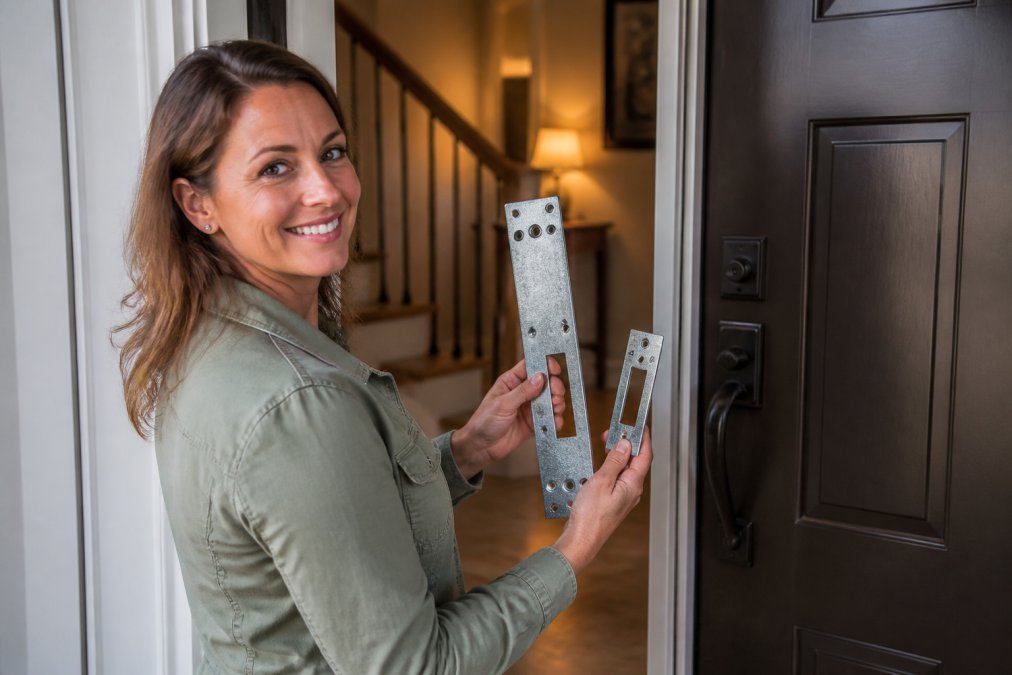
The product line covers three common entry configurations, each priced as a one-time purchase with no subscription:
| Kit | Price | Best For | Key Protection |
|---|---|---|---|
| Single Door Security Kit | $79.00 | Standard exterior doors | Kick-ins, prying, hinge attacks |
| Side Light Door Security Kit | $129.00 | Doors with sidelight windows | Jamb rigidity, frame anchoring |
| Double Door Security Kit | $149.00 | French or double doors | Full perimeter + Night Lock barricade |
The Single Door Kit fits doors up to 1-3/4 inches thick and includes hinge shields plus strike plate reinforcement. Side light doors lack a real jamb, so the Side Light Kit screws into the jamb face for rigidity. Double doors need a different approach, so the Double Door Kit includes a Night Lock barricade for the center gap.
Every kit carries a $500 Lifetime Guarantee against kick-ins. Police officers have tested and recommended these systems, and they have been featured in national media.
How to Prevent Door Kick-Ins: What Actually Works
A kick-in exploits a predictable failure chain: boot force transfers through the door to the latch, pushing against a strike plate anchored with screws that penetrate only 3/4 to 1 inch into soft pine. When the wood splits, the latch pops free.
The Force Path: Why Frames Fail
Most jambs are #2 or #3 grade pine, spruce, or fir, which flex under sudden impact. A kick delivering 200 to 400 foot-pounds bends the jamb, tears the wood around the screws, and rips out the strike plate. The door rarely fails; the frame is the weak link. Building codes like the IRC require solid-core or 1-3/8-inch-thick exterior doors but do not mandate reinforced jambs or strike plates.
The Two Viable Fixes: Reinforcement vs. Replacement
Homeowners have two paths to address this vulnerability:
Path 1: Full Door and Frame Replacement
This removes the existing door, jamb, and casing, then installs a new pre-hung unit. High-security options include:
- Steel doors with polyurethane foam cores: These offer excellent dent resistance and an R-value around R-5 to R-7, but the frame is still the weak point unless it is reinforced with steel or the studs are anchored.
- Fiberglass doors: These resist dents and corrosion better than steel, but they are only as strong as the jamb they hang in.
- Commercial-grade aluminum frames: These are rare in residential settings due to cost and thermal bridging issues.
A full replacement costs $1,200 to $3,500 installed. The security benefit is marginal unless the installer anchors the frame to wall studs with long screws or uses a reinforced steel jamb.
Path 2: DIY Reinforcement of the Existing Frame
This keeps the existing door and jamb but adds steel that transfers impact force into the wall structure. Standard strike plate screws are 1 inch; reinforcement kits use screws reaching 3 to 4 inches into the studs, or up to 8 inches when angled.
A Unique Angle: The Security Efficacy Gap
Reinforcement kits and full replacements are not equivalent. A full replacement with a standard jamb fails the same kick-in test as a builder-grade door, while a reinforcement kit on a sound frame can outperform a $3,000 replacement. Reinforced jambs with long screws into the studs can withstand multiple kicks and pry attempts, while unreinforced jambs may fail on the first or second attempt.
What Does Not Work
- Longer screws in the strike plate alone: This helps, but it does not protect the hinge side. Pry attacks on hinges are just as common as kick-ins.
- Deadbolts with hardened steel bolts: The bolt is strong, but the strike plate and jamb around it are still wood. The bolt will hold; the wood will not.
- Smart locks: A smart lock replaces the cylinder and keypad, but the latch and strike plate remain the same. Smart locks add convenience and monitoring, not physical resistance.
The Bottom Line for Homeowners
If your door and frame are sound, a DIY reinforcement kit anchoring into the studs is the most cost-effective solution. If the frame is rotted or you are replacing the door for aesthetics, a full replacement makes sense, but only with reinforced jambs or a reinforcement kit added.
International Code Council on residential exterior door requirements provides the baseline for what is legally required, but code minimums are not security recommendations. The gap between code compliance and actual forced-entry resistance is where reinforcement kits provide their value.
Door Security Reinforcement Kits: The Door Armor Difference
Reinforcement kits differ in materials, coverage, and installation quality. Many budget kits use thinner steel and only reinforce the strike plate, leaving hinges and jamb corners exposed. The Asafehome alternative for front doors that Door Armor provides is distinct because the strike plate reinforcement wraps around the jamb edge, creating a continuous steel barrier that prevents wood from flexing and splitting. It is a structural upgrade, not a surface-mounted plate.
Another differentiator is the $500 Lifetime Guarantee against kick-ins. Installation is designed for accessibility: kits include pre-drilled holes, all hardware, and clear instructions, with customer support available. The system installs without permanent damage, which matters for renters who want to take the kit when they move.
DIY Front Door Security Upgrades: Installation and Fit
The DIY-versus-professional decision hinges on your skill level, frame condition, and tolerance for the security consequences of an improper installation. Installation quality directly affects security efficacy.
The DIY vs. Professional Security Trade-Off
A kit is only as strong as its installation. The most common DIY failure is misaligning the strike plate so the deadbolt does not fully seat, or drilling pilot holes too wide, which strips the grip of the long screws.
DIY installation is feasible with basic tools: a variable-speed drill, #2 Phillips bit, tape measure, and pencil. It takes 30 to 45 minutes per door. The risk is not recognizing a rotted jamb or an offset stud, leaving the long screws nothing to bite into. Professional installation costs $150 to $400 per door, depending on region and jamb repairs, and is safer for homeowners with zero experience.
Installation Pitfalls That Compromise Security
Common mistakes that compromise security are:
- Oversized pilot holes:
- Ignoring jamb rot: Soft or spongy jamb wood crumbles under impact; water or termite damage must be repaired first.
- Misaligned strike plate: If shifted by even 1/8 inch, the deadbolt may not engage, and a kick will push it back.
- Skipping hinge reinforcement: Pry attacks on hinges succeed if hinge screws are the original 1-inch fasteners.
Fit Considerations by Door Type
| Door Configuration | Key Fit Challenge | Recommended Approach |
|---|---|---|
| Standard single door (1-3/4 inch thick) | Straightforward; most kits fit without modification | DIY is appropriate for most homeowners |
| Door with sidelights | No real jamb on the latch side; kit must screw into the face of the sidelight frame | Professional recommended; requires precise measurement of the sidelight frame depth |
| Double doors | Center gap has no jamb; requires a barricade or flush bolt system | Professional recommended; alignment of both doors is critical |
| Non-standard thickness (over 1-3/4 inch) | Standard kits may not fit; check manufacturer specifications | Measure door thickness before ordering; custom shims may be needed |
Preserving Curb Appeal: The Visual Aesthetics Gap
A significant concern is that security hardware will make a front door look like a commercial entrance, a legitimate worry most security guides ignore. Modern kits are discreet: components come in satin nickel or matte black to match residential hardware, the strike plate reinforcement looks like a slightly larger standard plate, and hinge shields install on the interior side, invisible from the street. The only visible clue is a slightly wider strike plate. High-security doors should not advertise themselves, as that can attract attention rather than deter it.
What to Verify Before You Start
- Door thickness: Measure the edge of the door with a tape measure. Standard is 1-3/4 inches. If you have a 1-3/8-inch interior door used as an exterior door, you need a different kit.
- Jamb condition: Press on the jamb near the strike plate. If it flexes or feels soft, you have rot or insect damage.
- Stud location: Use a stud finder to confirm there is a stud within 2 inches of the strike plate side of the jamb. If not, you will need a different anchoring strategy.
- Deadbolt throw: Measure how far the deadbolt extends. A 1-inch throw is standard; anything less is a security risk.
International Association of Certified Home Inspectors guidance on entry door hardware recommends that homeowners inspect strike plate screws and jamb condition as part of routine home maintenance. Loose or stripped screws are the most common vulnerability and the easiest to address with a reinforcement kit.
The Verdict: DIY or Hire Out?
With basic drill experience, a sound jamb, and a standard door, DIY is safe and cost-effective. With sidelights, double doors, or jamb damage, hire a professional. The visual outcome is a front door that looks normal from the street but resists forced entry at the structural level.
Which Door Armor Kit Is the Right Asafehome Alternative for Your Front Door?
The right kit depends on your door configuration. For a standard single exterior door, the Single Door Security Kit at $79.00 covers the lock area, strike plate, and hinges in one package. Choose the Side Light Door Security Kit at $129.00 for sidelight windows, which are hardest to protect because there is no real jamb; the Sidelight Jamb Shield screws into the jamb face for rigidity. For double or French doors, the Double Door Security Kit at $149.00 uses a Night Lock barricade to secure the center gap.
| Your Door Type | Recommended Kit | Price | Estimated Installation Time |
|---|---|---|---|
| Single exterior door | Single Door Security Kit | $79.00 | ~30 minutes |
| Door with sidelights | Side Light Security Kit | $129.00 | Under 30 minutes |
| Double or French doors | Double Door Security Kit | $149.00 | Under 30 minutes |
Integration with smart home security is straightforward. Door Armor works alongside smart locks, video doorbells, and alarms because it secures the physical structure, not the locking mechanism. A smart lock alerts you; Door Armor prevents the intrusion. For renters, installation does not permanently damage the door or frame, and kits can be removed and reinstalled at a new property.
National Crime Prevention Council resources on home security hardening emphasizes that layered security approaches combining physical reinforcement with electronic monitoring provide the most effective protection against residential burglary.
Conclusion
Securing your front door does not require replacement or compromising appearance. A Door Armor kit addresses structural weak points, using galvanized steel anchored deep into the wall frame to stop kick-ins and prying.
Door Armor has protected over 500,000 doors, backed by the $500 Lifetime Guarantee. Kits install in about 30 minutes with basic tools, work with smart home hardware, and remain discreetly matched to your fixtures.
Get started with Door Armor and reinforce your front door against forced entry today.
Frequently Asked Questions
What makes a good Asafehome alternative for front doors?
A good alternative focuses on the same weak points: the jamb, strike plate, and hinges. Door Armor kits use galvanized steel to reinforce these areas, preventing the door frame from splitting during a kick-in. Unlike simple door braces, this addresses the structural integrity of the frame itself. Look for a kit that includes a jamb shield, strike plate reinforcement, and hinge shields for complete protection. The best options are those tested against real forced entry attempts.
Are door security reinforcement kits worth the investment?
Yes, because they address the most common point of forced entry. A standard door frame can splinter with a single strong kick. A $79 Door Armor Single Door Security Kit reinforces the jamb and strike plate with steel, making a kick-in significantly harder. This small cost protects against thousands of dollars in potential damage and theft, making it a high-value upgrade for any homeowner focused on residential security.
Can I install door reinforcement hardware myself?
Yes. Door Armor kits are designed for DIY installation in about 30 minutes. The process involves removing the existing strike plate and door trim, then attaching the steel Jamb Shield and Strike Plate with the included long screws. You do not need to be a professional carpenter. The kit includes clear instructions, and Door Armor offers support if you have questions during your DIY front door security upgrade.
How does Door Armor compare to other door security products?
Many basic kits only reinforce the strike plate. Door Armor takes a more complete approach by also shielding the door jamb and hinges. This matters because a kick-in can shatter the jamb itself. Door Armor's galvanized steel system is police-recommended and comes with a $500 Lifetime Guarantee against kick-ins. This combination of complete coverage, proven testing, and warranty makes it a strong choice for front door security.
Shop Now and choose the kit that fits your door configuration.