 listicle
Alternatives to Professional Security Monitoring in 2026
Table of Contents
- Why Homeowners Are Ditching Professional Security Monitoring
- Quick Comparison: Self-Monitoring vs. Professional Monitoring
- Physical Door Reinforcement vs Electronic Alarms
- Self-Monitored Home Security Pros and Cons
- Best Home Security System Without Monthly Fee: Door Armor
- Emergency Response Protocols for DIYers
- Liability, Insurance, and Privacy Trade-offs
- Conclusion: Build a Layered Defense That Works for You
- Frequently Asked Questions
Last Updated: September 8, 2026
Why Homeowners Are Ditching Professional Security Monitoring
Monthly subscription fees for professional security monitoring keep climbing, yet the hardware itself has never been more affordable. That disconnect is pushing a growing number of homeowners toward alternatives to professional security monitoring that eliminate recurring costs while keeping the protection. The shift isn't about cutting corners; it's about recognizing that a monitored alarm only helps if you actually arm it, and many people don't once the novelty wears off.
At Door Armor, we've spent over 20 years reinforcing doors against forced entry, and we've watched this trend accelerate. Homeowners are realizing that most break-ins are opportunistic, not coordinated heists. A burglar testing a door for 30 seconds and failing is gone, subscription or not.
The real question isn't whether you need protection. It's whether you need to pay someone every month to watch a sensor you could monitor yourself. For many, the answer is no.
Quick Comparison: Self-Monitoring vs. Professional Monitoring
Self-monitoring puts alert delivery in your hands through push notifications and remote access, while professional monitoring routes those signals to a central station that can request emergency dispatch. The trade-off comes down to who responds when you can't.
| Option | Monthly Cost | Response | Best For |
|---|---|---|---|
| Professional Monitoring | $20-$60/month | Central station dispatch | Frequent travelers, hands-off owners |
| Self-Monitoring | $0/month | Your phone alerts | Budget-conscious, tech-comfortable owners |
| Physical Reinforcement | $0/month | Always active, no power needed | Everyone, as a baseline layer |
Professional monitoring shines when you're away for extended periods. Self-monitoring works well for most homeowners who keep their phones nearby. Physical reinforcement, however, never sleeps and never needs a battery backup.
Physical Door Reinforcement vs Electronic Alarms
Electronic alarms detect an intruder after entry begins. Physical door reinforcement stops the entry from happening in the first place. That distinction matters more than most security guides admit.
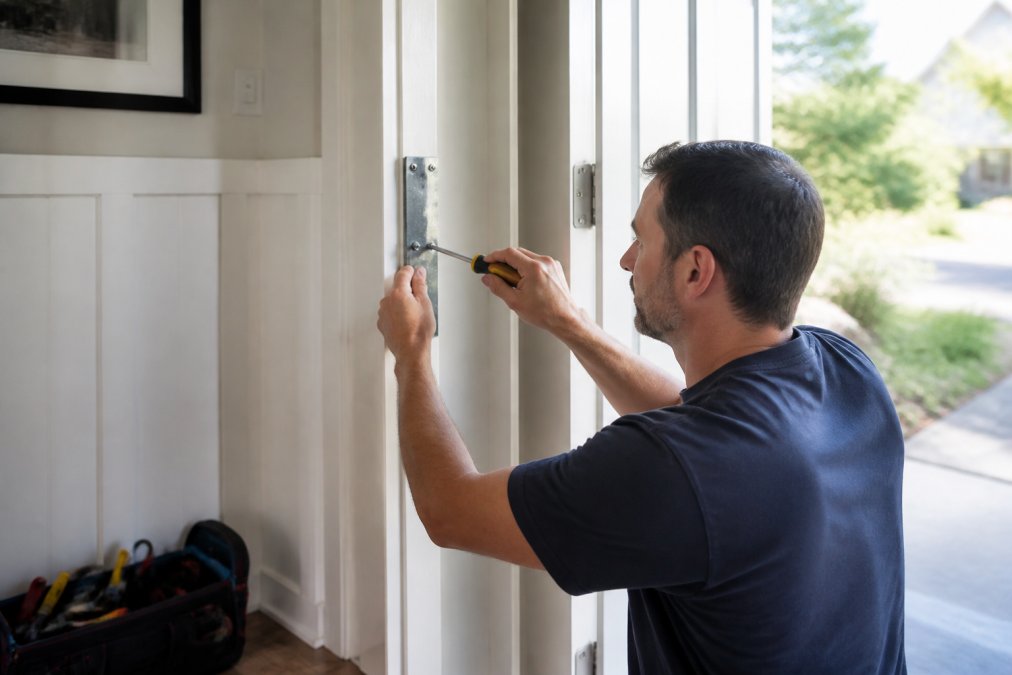
Alarms and cameras are valuable, but they document a crime. Reinforced doors prevent it. A motion sensor goes off when someone is already inside your home, which means you're now dealing with a face-to-face confrontation. A reinforced door jamb means the kick-in attempt fails, and the intruder moves on to an easier target.
The most effective approach isn't choosing one over the other. It's layering both: electronic monitoring for awareness, physical reinforcement for actual prevention. This layered strategy addresses the weak points of each system, covering gaps in coverage and response times.
Self-Monitored Home Security Pros and Cons
Self-monitored home security pros and cons deserve honest evaluation before you commit. The advantages are real: no monthly subscription fees, full control over your system, and no contract lock-in. You own the hardware outright, and you decide who gets alerts and when.
The drawbacks are equally real. You are the emergency dispatch. If a break-in happens while you're asleep or away from your phone, nobody is calling the authorities for you. Response depends entirely on your awareness and your ability to act quickly.
But the gap most comparison guides skip is what happens after the honeymoon period ends. A professionally monitored system comes with a support team that handles the mundane failures that plague DIY setups. When you self-monitor, you inherit that entire workload. Here is what that actually looks like in year two and beyond.
Battery Life Is Now Your Problem. Most wireless sensors run on CR123A or AA lithium batteries rated for 2-5 years. That rating assumes ideal conditions. Cold garages, frequent trips, and high-traffic entry points drain them faster. A dead sensor doesn't announce itself; it just stops reporting. Professional monitoring centers run continuous supervisory signals that flag low-battery conditions weeks in advance. Self-monitoring apps vary widely, some alert you at 10% remaining, others go silent until the sensor is already offline. Build a recurring calendar reminder to test every sensor monthly and replace batteries on a fixed schedule rather than waiting for a failure.
Wi-Fi Outages Blind Your System. A self-monitored system that relies on cloud connectivity is only as reliable as your internet service. If your router drops, so do your alerts. Most consumer routers reboot in under two minutes, but an outage during a 3 a.m. intrusion window is exactly when you need the system most. The fix is a cellular backup module (typically $10-$15 per month from providers like Ring or SimpliSafe) or a UPS battery backup for your router and modem (around $50-$100 one-time). If you skip both, accept that your system is offline whenever your ISP hiccups.
False Alarm Fatigue Is Real. Professional monitoring centers triage alarms and filter obvious false triggers before dispatching authorities. Self-monitoring pushes every event to your phone. After the tenth notification from a spider crawling past a motion sensor at 2 a.m., most homeowners start silencing alerts or disabling zones entirely. That gradual disarmament is the single biggest failure mode of DIY security. Combat it by zoning sensors intelligently, motion detectors in common areas only during away mode, contact sensors on entry doors always active, and by choosing equipment with good pet-immunity ratings (most quality sensors handle pets up to 50-80 pounds).
Firmware and App Updates Require Vigilance. Professional systems get pushed updates by the provider. DIY systems require you to check for app updates, reboot hubs, and re-pair sensors after firmware changes. A sensor that drops off your network after an update is a silent gap until you notice it missing from the device list. Schedule a quarterly system audit: open the app, verify every sensor shows online, test each one physically, and confirm notifications are actually arriving on your phone.
Many homeowners find these trade-offs acceptable, especially when they pair self-monitoring with physical barriers that buy critical time. A reinforced door that takes minutes to breach gives you far more opportunity to respond than a standard door that fails in seconds. But the honest assessment is that self-monitoring isn't zero-maintenance, it's maintenance you perform yourself instead of paying someone else to perform for you.
Best Home Security System Without Monthly Fee: Door Armor
The best home security system without monthly fee isn't a gadget that requires a subscription to function. It's a physical upgrade to your existing doors that works every second of every day, regardless of power, Wi-Fi, or cellular backup.
Door Armor's patented galvanized steel reinforcement system addresses the structural weak points that burglars exploit: the jamb, the hinges, and the lock area. Our Single Door Security Kit starts at $79.00 and installs in under 30 minutes with basic tools. The Double Door Security Kit, priced at $149.00, includes a Night Lock door barricade for doors without a center jamb. For sliding glass doors, the Armor Latch Sliding Door Deadbolt at $39.99 prevents intruders from lifting the door off its track.
Every Door Armor kit comes with a $500 Lifetime Guarantee against kick-ins. That's our confidence in writing. Police departments recommend our system because they've seen what happens to standard door frames during forced entry attempts. With 500,000+ doors secured, this isn't theoretical protection.
Emergency Response Protocols for DIYers
When you self-monitor, you need a clear emergency response protocol before an incident occurs. Decide now what you'll do when an alert fires, because hesitation in the moment costs precious seconds.
First, verify the threat. Check your camera feeds or listen for sounds before assuming a false alarm. Many self-monitoring systems generate false alarms from pets or environmental triggers, and false alarm reduction starts with confirmation.
Second, if the threat is real, call emergency services immediately. Don't post to social media first. Don't confront the intruder. Your priority is getting help dispatched while you and your family stay safe.
Third, retreat to a secure room. This is where physical reinforcement proves its worth. A reinforced bedroom door with a Night Lock barricade gives you time to wait for responders while keeping a barrier between you and the threat.
Liability, Insurance, and Privacy Trade-offs
Choosing alternatives to professional security monitoring carries implications beyond your monthly budget. The financial and legal consequences of that choice are rarely covered in depth, yet they can outweigh the subscription savings. Here is what the fine print actually says.
Insurance Discounts: The Verification Problem. Many homeowners assume any security system earns an insurance discount. In practice, most carriers require one of two things: a central station that can verify an alarm before dispatching authorities, or a professionally installed system with a certificate of installation. Self-monitored systems with push notifications rarely qualify for the same discount tier. Some carriers offer a smaller discount (typically 5-10% versus 15-20% for professionally monitored) if the system includes video verification, meaning cameras that let you or a monitoring center confirm an intrusion visually before calling police. The mechanism matters: insurers want proof that a false alarm won't trigger an unnecessary emergency response, which costs them money. Check your policy's specific language. If your carrier requires central station monitoring for the discount, calculate whether the annual savings justify the monthly fee, for many homeowners, a $20/month monitoring fee is offset by a $300/year discount, making the professional option financially rational despite the recurring cost.
Liability When You Miss an Alert. Self-monitoring shifts liability from the monitoring company to you. If a professional monitoring center fails to dispatch after a verified alarm, they carry contractual liability. When you self-monitor, that responsibility is yours alone. If you're on vacation with your phone on silent, or if you dismiss an alert thinking it's a false alarm, and a burglary occurs, you have no third party to hold accountable. This is a real legal exposure that most DIY security guides omit entirely. The practical mitigation is a documented response plan and redundant notification paths, ensure alerts reach multiple devices and ideally a trusted neighbor or family member who can act if you're unreachable.
Physical Deterrence and Liability Reduction. A reinforced door that stops a kick-in attempt prevents property damage and potential injury to occupants, that's a liability win. But physical security measures also carry a duty-of-care consideration. If you install reinforcement that makes entry significantly more difficult, an intruder may instead break a window to gain access. That's not a liability problem for you, but it's worth understanding that hardening one entry point can shift attempts to another. The layered approach, reinforcing all ground-floor entry points, addresses this by eliminating the path of least resistance.
Privacy-First Local Storage: The Angle Most Guides Miss. Professional monitoring means a third party has data about when you're home, when you're away, and what your sensors detect. That data is stored on the provider's cloud servers, subject to their retention policies, their security practices, and potentially law enforcement requests. Self-monitoring with local storage keeps that data entirely on your devices, reducing exposure to cloud storage breaches. The trade-off is real: local storage means you manage your own backups, and if a thief steals your recorder along with your valuables, your footage is gone. A hybrid approach, local storage for continuous recording plus cloud upload only for triggered events, balances privacy with redundancy. For privacy-conscious homeowners, this trade-off alone justifies the switch, but it requires understanding what your equipment actually does with your data before you buy.
The Bottom Line on Trade-offs. The decision between professional and self-monitoring isn't just a monthly cost comparison. It's a calculation that includes insurance premium impacts, liability allocation, and data privacy. Run the numbers with your specific policy and your specific equipment before you commit, the cheapest option on paper isn't always the cheapest option in practice.
Conclusion: Build a Layered Defense That Works for You
Alternatives to professional security monitoring aren't about accepting less protection. They're about choosing protection that fits your lifestyle, your budget, and your privacy expectations. A layered defense combining self-monitored electronics with physical door reinforcement addresses the weaknesses of each approach while maximizing your home's resistance to forced entry.
The most reliable layer is the one that never needs a signal, never drains a battery, and never depends on someone else's response time. That's what Door Armor delivers. Our galvanized steel reinforcement, backed by a $500 Lifetime Guarantee and trusted by police departments, stops kick-ins and prying attempts at the source.
Get started with Door Armor and secure your entry points with a one-time investment that protects your family around the clock, no monthly fees required.
Frequently Asked Questions
Can you have a reliable security system without a monthly monitoring fee?
Yes. A reliable system combines physical door reinforcement, like Door Armor's Single Door Security Set at $79, with self-monitoring tools such as cameras and motion sensors. Physical barriers stop forced entry at the source, while alerts keep you informed. This approach eliminates recurring costs and remains effective as long as your equipment functions. The key is ensuring your weakest entry points, usually doors, are secured first.
What is the best non-monitored alarm system for homeowners?
The best non-monitored system addresses both detection and prevention. For detection, look for cameras with local storage and motion sensors that send push notifications. For prevention, physical reinforcement is critical. Door Armor's kits, starting at $39.99 for the Armor Latch Sliding Door Deadbolt, physically block entry. A non-monitored system is only as strong as your home's physical barriers.
What are the pros and cons of self-monitoring your home security?
Self-monitoring pros include no monthly subscription fees, no contracts, and full control over your system and data. Cons include the responsibility of checking alerts and contacting emergency services yourself, plus the lack of professional dispatch if you are away or unable to respond. Combining self-monitoring with robust physical door reinforcement mitigates these cons by providing always-active protection that does not rely on your immediate response.
How do physical door reinforcements compare to electronic monitoring?
Electronic monitoring detects a break-in as it happens and alerts you or a call center. Physical door reinforcement, such as Door Armor's galvanized steel shields, prevents the break-in from occurring in the first place. Monitoring is reactive; reinforcement is proactive. Forced entry through a door is a primary method for burglars, so stopping that attack physically is a critical layer that electronic alarms cannot provide.